Wednesday, April 30, 2025

Tariffs and Turning Points: How Trump’s Trade War Opens Doors for the Philippines

Introduction

The economic conflict between China and the United States has persisted since January 2018, when U.S. President Donald Trump initiated tariffs and other trade barriers against China. The goal was to compel China to address what the U.S. identifies as longstanding unfair trade practices and intellectual property theft. The first Trump administration argued that these practices could contribute to the U.S.–China trade deficit and claimed that the Chinese government mandated the transfer of American technology to China.

In response to U.S. trade actions, the administration of Chinese Communist Party General Secretary Xi Jinping accused the Trump administration of engaging in nationalist protectionism and implemented "countermeasures." As the trade war escalated throughout 2019, the two sides reached a tense phase-one agreement in January 2020. By the end of Trump's first term, American media outlets widely portrayed the trade war as a failure for the United States, highlighting the crucial role of trade conflicts in shaping global economic opportunities.

The Biden administration maintained existing tariffs and imposed new levies on Chinese products, including electric vehicles and solar panels. In 2024, the Trump presidential campaign proposed a substantial 60 percent tariff on Chinese imports. On February 1, 2025, the second Trump administration raised tariffs on China by 10 percent, followed by another increase of 10 percent on March 4. 

On March 10, China imposed a 15% tariff on American goods, especially agricultural products. By April 2, 2025, the Trump administration raised the total import tariff on China to 54%, leading to China's promise of retaliation. In 2025, the conflict escalated, resulting in the U.S. imposing a 145% tariff on Chinese goods and China retaliating with a 125% tariff on American products, causing a projected 0.2% loss in global merchandise trade. 

After the 125% tariff on April 12, 2025, China announced it would ignore any further U.S. tariffs, stating the current levels made U.S. imports untenable. The U.S. later excluded Chinese cellphones, computers, and electronics from some tariffs.

Impact of Trump's Tariffs 

President Trump has threatened to impose special tariffs on products imported from countries such as Canada, Mexico, and China. These tariffs would focus on imports related to the drug fentanyl and items crucial to national security, including cars, car parts, steel, and aluminum.

If these tariffs go into effect, the average import tariff rate will rise significantly to about 25.8%. However, after accounting for reduced imports, as higher prices usually lead to fewer purchases, the effective tariff rate will be about 11.3%. This would be the highest rate the U.S. has seen since World War II. These new tariffs could cause imports to drop by nearly $800 billion, or 23%, in 2025.

If recent trends continue, the United States could impose tariffs as high as 145% on Chinese goods, prompting a retaliatory 125% tariff from China. Such a development could shave 0.2% off global merchandise trade.

These tariffs will reduce the U.S. economy by approximately 0.8% before considering other countries' responses. When retaliation from different countries is factored in, the total economic loss increases to about 1.0%.

The tariffs are expected to reduce the average household's after-tax income by about 1.2%, translating to an extra $1,243 tax per household in 2025. Additionally, consumers might face reduced options because of the higher prices.

Countries like China, Canada, and those in the European Union have already retaliated with their own tariffs, impacting approximately $330 billion worth of American exports. These measures will further decrease the U.S. economy by another 0.2%.

In 2025 alone, Trump’s tariffs are projected to raise federal taxes by $166.6 billion, marking the most significant tax increase since 1993 and surpassing those implemented by Presidents George H.W. Bush and Obama.

In 2018 and 2019, tariffs covered about $380 billion of U.S. imports. The current "reciprocal" tariffs cover approximately $1.3 trillion of imports from nearly all U.S. trading partners except Canada and Mexico. Additional tariffs targeting fentanyl, steel, aluminum, and cars affect another $518 billion of imports. In total, approximately $2.3 trillion (71%) of U.S. imports now face higher tariffs.

Overview of the Impact of Trump’s Tariffs on Major US Industries

• Automotive Industry:

Trump’s tariffs on imported steel, aluminum, and automotive parts have increased production costs for U.S. automakers, which may translate into higher vehicle prices for consumers and a potential dip in sales. However, these same tariffs aim to incentivize domestic manufacturing and lessen dependence on foreign suppliers. Over time, this could encourage investment in local supply chains and provide a competitive edge to American-made vehicles, fostering job growth in the U.S. manufacturing sector.

• Steel and Aluminum:

Domestic steel and aluminum producers experienced a notable boost due to reduced competition from foreign imports, leading to higher capacity utilization and job creation in those sectors. Still, downstream industries such as construction, automotive, and appliance manufacturing faced rising material costs, which may offset some of these gains. Overall, the tariffs created short-term advantages for primary producers but challenged industries that rely on affordable inputs.

• Agriculture:

Tariffs led to retaliatory measures from trading partners, especially affecting key exports like soybeans, pork, and dairy products. This caused economic pain for many U.S. farmers. In response, however, the U.S. government provided aid packages to mitigate losses, and the trade disputes encouraged American producers to diversify export markets beyond China, fostering long-term resilience and reducing overdependence on a single trading partner.

• Technology and Electronics:

The imposition of tariffs raised the cost of imported components and finished products, resulting in higher consumer prices and potentially reduced sales. Yet, this disruption has prompted some U.S. tech firms to consider reshoring part of their supply chains or exploring alternative suppliers in non-tariffed regions, such as Southeast Asia. This could lead to more secure and flexible sourcing strategies and even drive domestic innovation in component production.

• Retail and Consumer Goods:

Retailers faced increased costs on imported goods such as clothing, footwear, and appliances, often passing these costs onto consumers. Despite these challenges, the tariffs presented an opportunity for U.S. manufacturers and artisans to fill market gaps with local alternatives. Some retailers began exploring domestic and regional supply networks, potentially revitalizing small-scale manufacturing and offering new avenues for local entrepreneurs.

• Pharmaceutical and Chemical Industries:

Tariffs on imported chemicals and pharmaceutical precursors, including ingredients for drugs like fentanyl, strained the supply chain and threatened higher prices. On the other hand, this encouraged discussions about reducing foreign dependence for critical medical supplies, spurring interest in rebuilding domestic production capabilities, which could enhance national health security over time.

• Trade and Logistics:

The increased cost of imports and reduced trade volumes initially created headwinds for shipping and logistics firms. However, some sectors benefitted from a reshuffling of trade flows, with new shipping routes and inland infrastructure investments adapting to emerging patterns. The tariffs also accelerated strategic decisions in logistics optimization and warehousing closer to end markets, boosting domestic freight activity.

Summary

In summary, Trump’s tariff approach seeks to shift the trade balance toward American industry and national priorities. The strategy disrupted supply chains and stirred debate, yet it also provoked a rethinking of sourcing, domestic production, and long-term competitiveness.

Tariffs brought both pain and potential: challenges to consumer affordability, global competitiveness, and sectoral growth coexisted with new investment opportunities, industrial reshoring, market diversification, and a revived conversation on economic self-reliance. 

The ultimate outcome depends on how businesses and policymakers use these disruptions to promote structural reform, innovation, and long-term strategic positioning in the global economy.

Opportunities for the Philippines

  • Potential growth in manufacturing exports (electronics, automotive parts, garments)

The Philippines benefits from one of the lowest U.S. tariff rates among Southeast Asian nations, providing a competitive edge over countries such as Vietnam and Thailand, which face higher tariffs. Approximately 33% of Philippine exports to the U.S., particularly in electronics and semiconductors, are exempt from new tariffs, facilitating growth in these high-value sectors. This tariff advantage enables the Philippines to expand its market share in garment and coconut product exports. Furthermore, the favorable tariff environment may encourage foreign manufacturers to invest in the country, driving job creation and economic growth.

  • Increasing agricultural exports (fruits, seafood, processed food)

The Philippines has a competitive advantage in U.S. tariff rates compared to neighboring Southeast Asian countries, with lower rates benefiting its agricultural exports. Key exports such as coconut oil and canned pineapple hold potential for increased market share. The Department of Agriculture is diversifying export markets by targeting areas like the Middle East and the EU to reduce reliance on the U.S. Additionally, lower tariffs may attract foreign investment in manufacturing, which would boost the agricultural sector and create jobs.

  • Attracting Investment from Companies Leaving China 

The Philippines enjoys a competitive tariff advantage over its neighboring countries, imposing a 17% tariff on exports to the U.S., which attracts foreign investment. Its strategic location in Southeast Asia facilitates access to major Asia-Pacific markets, enhancing its role as a manufacturing hub. The government has implemented tax reforms and initiatives to promote economic zones and infrastructure development, which appeal to foreign firms, particularly those from China. Additionally, the country is concentrating on critical industries like nickel processing to strengthen its position in the electric vehicle battery supply chain.

  • Expansion in Business Process Outsourcing (BPO) and Knowledge Process Outsourcing (KPO)

While tariffs do not directly affect service exports, the ripple effect of rising costs and shifting supply chains has prompted U.S. firms to seek greater operational efficiency. The Philippines, with its English-speaking workforce and established digital infrastructure, remains a global leader in BPO. Opportunities extend into KPO services such as legal support, finance, healthcare, and IT. This shift bolsters revenue inflows and supports job creation in provincial digital hubs under the government’s "Digital Cities 2025" program.

  • Boosting electronics manufacturing services (EMS) and semiconductor assembly

The Philippines is well-positioned to benefit from the diversification of the U.S. electronics supply chain. With American companies seeking alternatives to China, the country’s existing expertise in semiconductor packaging and assembly can be scaled up. Major electronics firms, such as Texas Instruments, Analog Devices, and ON Semiconductor, already operate in Philippine economic zones, indicating their readiness for expansion.

  • Tourism-related investment and services

Although not a direct consequence of tariffs, regional economic rebalancing has spurred investor interest in stable, culturally aligned markets. The Philippines can attract foreign investment in tourism infrastructure—especially in niche areas like eco-tourism, wellness, and medical travel—by leveraging its natural assets and competitive service costs. American tourist arrivals and U.S.-linked resort developments could increase amid shifts in regional business priorities.

  • Development of green energy and sustainable export industries

As global firms seek ESG-compliant supply chains and reduce environmental risks linked to China, the Philippines can promote its potential in green manufacturing and sustainable exports. Opportunities exist in organic agriculture, renewable energy components, and ethical textiles. The country’s inclusion in the EU’s GSP+ scheme and its historical participation in the U.S. GSP (pending renewal) make its sustainable goods more appealing to Western buyers.

  • Niche export growth in creative industries (animation, game development, digital media)

With increased scrutiny of China’s digital content and outsourcing restrictions, Western companies are redirecting creative and digital media work to other markets. The Philippines, with its artistic talent pool and Western cultural alignment, is emerging as a hub for animation, gaming, and digital content production. This sector represents a high-value, low-resource path to export growth with significant potential for upskilling and innovation.

A Proactive Economic Policy Response by the Philippines To Trump's Tariffs 

At the time of this writing, Mr. Trump has announced a 90-day pause on the higher reciprocal tariffs imposed on most of the US’ trading partners, including members of the Association of Southeast Asian Nations (ASEAN). 

The US previously imposed some of the highest tariffs on ASEAN countries, resulting in significant impacts: Cambodia faces a staggering 49% tariff, followed closely by Laos at 48%, Vietnam at 46%, Myanmar at 44%, Thailand at 36%, Indonesia at 32%, Malaysia at 24%, and Brunei at 24%.

In contrast, the Philippines has been subjected to a much lower tariff of 17%, second only to Singapore’s baseline rate of 10%. This comparatively low rate gives the Philippines a competitive edge, making it an attractive destination for foreign direct investments and for companies looking to relocate their orders to countries with lesser tariffs.

With the 90-day pause now enforced, all countries, including the Philippines, will experience a blanket 10% duty set to last until July. The immediate future holds a precarious balance for the Philippines as it navigates these changes.

In light of these developments, the Philippines must intensify its efforts to enhance competitiveness in attracting investments. Understanding Trump's unpredictable nature is crucial—he may spring another "shocker" at any moment, altering the landscape entirely.

For the Philippines, this is no time for complacency. It must sharpen its competitive edge, act decisively, and anticipate shifting dynamics in the global marketplace.

In a world where competition intensifies daily, the focus must pivot toward improving capacities in critical sectors like agriculture, electronics, minerals, and garment and apparel manufacturing. 

The stakes are high, and the time for action is now. Will the Philippines seize this opportunity to redefine its place in the global market, or will it allow itself to become overshadowed by its competitors? The future hangs in the balance, and the nation must prepare to confront the challenges ahead with unwavering resolve. 

Now or never—it's time for the Philippines to transform its potential into undeniable progress.

References

Amadeo, K. (2020, January 15). U.S.-China trade war and its impact on the global economy. The Balance.

Animation Council of the Philippines, Inc. (ACPI). (n.d.). About Us.

Bown, C. P. (2023). The US-China trade war and phase one agreement. Peterson Institute for International Economics Report.

Congressional Research Service. (2024). U.S. tariff policy: Overview (CRS Report IF11030). Library of Congress.

Department of Trade and Industry (DTI). (2023, April 19). Two new PEZA economic zones proclaimed by MalacaƱang.

Hufbauer, G. C., & Jung, E. (2025). Estimating the economic impact of Trump’s tariffs. Peterson Institute for International Economics Policy Brief.

Matchboard. (2024, April). Outsourcing to the Philippines – the state of play.

Office of the United States Trade Representative. (2024). Section 301 investigation: China's acts, policies, and practices related to technology transfer, intellectual property, and innovation. Executive Office of the President, Washington, D.C.

Outsource Accelerator. (2025, February). BPO sector drives Philippine economic growth in 2025: Citi.

Philippine Economic Zone Authority (PEZA). (n.d.). Ecozones In-Depth: Eco-Industrial Parks & Green Technologies.

Reuters. (2024, March 19). Philippines sees up to $6 bln of investments in casino sector in next 5 years.

Reuters. (2025, March 11). China imposes retaliatory tariffs on U.S. agricultural products. Reuters Business News.

Semiconductor and Electronics Industries in the Philippines Foundation, Inc. (SEIPI). (2023, October). Philippine Electronics Export Performance – October 2023.

Tankersley, J., & Swanson, A. (2025, April 3). Trump administration raises tariffs on Chinese goods to 145 percent. The New York Times, p. B1.

Trading Economics. (2024). Philippines Exports of electrical, electronic equipment to United States.

United States International Trade Commission. (2024). Economic impact of Section 232 and 301 tariffs on U.S. industries (USITC Publication 5175). Washington, D.C.: Government Printing Office.

Vitrina AI. (2024). Top Best Animation Studios and Companies in Philippines | 2024.

World Trade Organization. (2025). Global merchandise trade outlook amidst U.S.-China trade conflict. WTO Press Release No. 902.



Monday, April 21, 2025

Breaking the Loop: How Filipino Cinema Can Rise from Mediocrity to Mastery

Introduction

Filipino cinema is not dying—it is sleepwalking through a coma of commercial complacency, institutional neglect, and cultural mediocrity. It is not a lack of talent that chains it to obscurity, but a system that rewards the safe and punishes the daring. 

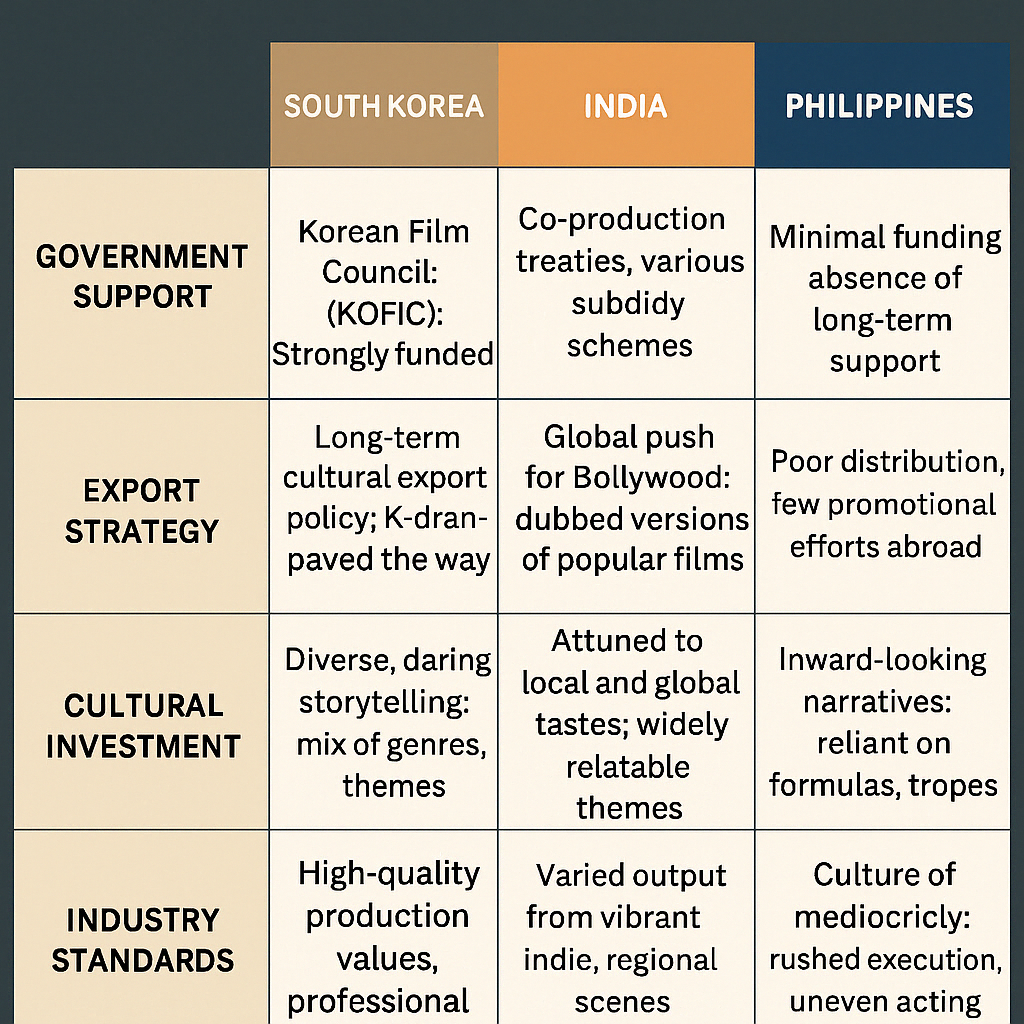
While Korean and Indian films have burst into the global imagination with cinematic force, Filipino films remain largely inward-looking, safe, and saturated with recycled formulas. The bitter truth is that we have built a film culture that is more comfortable with applause from the familiar than with admiration from the world.

The Vicious Cycle of Mediocrity

Let’s name the rot: the "pwede na yan" mentality. Mediocrity is not just tolerated in the mainstream Philippine industry—it is institutionally preferred. Movie stars are chosen for Instagram following, not acting ability. Directors are told to imitate past box-office hits rather than innovate. Producers are allergic to risk, clinging to love teams and slapstick comedy like lifeboats in a storm.

Scriptwriters regurgitate plots with little emotional depth or narrative ambition. Subpar cinematography, weak sound design, poor subtitling, and shallow character arcs are normalized because the market accepts and even celebrates them. Filipino audiences deserve better, but years of creative starvation have numbed their appetite.

A Culture of Mediocrity

This mediocrity is not accidental—it is cultivated. In schools, in media, and even in politics, excellence is often viewed with suspicion while conformity is rewarded. In the film industry, this manifests in the repeated celebration of superficial spectacle over substance. There’s a systemic unwillingness to invest in quality, from writing and acting to post-production. Everything becomes a race to meet deadlines, satisfy sponsors, and ride trends, with little care for lasting value. When mediocrity is not only allowed but applauded, greatness becomes the anomaly instead of the goal.

The Problem of Inward-Looking Storytelling

Too many Filipino films assume the viewer is steeped in local culture. They indulge in references that alienate foreign audiences, or worse, pander awkwardly to them. We don’t tell stories that travel—we tell stories that stay home.

Contrast this with Korea’s cinematic triumphs: Parasite, Burning, Train to Busan. These are deeply Korean in setting yet universal in their themes—class, grief, survival, identity. India’s rise is even more staggering. From RRR to Lunchbox, Indian cinema has embraced a dynamic range of genres and narratives, supported by a powerful domestic industry and a diaspora eager to see themselves reflected truthfully.

Both countries have institutions that support film as an export, not just as local entertainment. The Korean Film Council (KOFIC) offers funding, training, and distribution assistance. India’s National Film Development Corporation (NFDC) cultivates talent and brings indie films to Cannes and Berlin.

What is the Philippine equivalent?

Governmental and Industrial Apathy

Our state support is fragmented. Institutions like the FDCP (Film Development Council of the Philippines) are underfunded and burdened by bureaucracy. Film festival grants are short-term solutions, not long-term investments. There is no unified strategy to build cultural soft power through cinema.

Meanwhile, platforms like Netflix and Amazon Prime are hungry for content, but most Filipino films lack the production polish or narrative tightness to compete globally. Many fail to meet even basic technical standards—poor subtitling alone can kill international appeal.

The Culture of Safe Success

Creativity demands courage. But in a culture where careers are built on mass appeal and awards are given based on star power, courage is rarely rewarded. Critics are either fanboys or sidelined. Our entertainment media reinforces mediocrity with sycophantic praise and zero serious discourse.

Even the audience must share the blame. We’ve been complicit in celebrating mediocrity. We buy into the hype, stream garbage for the sake of loyalty, and mock those who dare to challenge the system.

The Way Out: A Strategic Framework for Reviving Filipino Cinema

Reversing the decline of Filipino cinema requires more than platitudes or isolated success stories—it demands a deliberate, well-funded, and institutional response. The following eleven-point framework is not merely aspirational; it is an actionable roadmap rooted in global best practices, cultural industry development, and film industry strategic engagement.

1. Increase Strategic Investment in Film

Sustainable growth hinges on diversified funding mechanisms. Government subsidies, private sector incentives, and crowdfunding platforms must be synchronized to fund high-quality productions, modernize equipment, and professionalize the workforce. With adequate capital, Filipino filmmakers can pursue innovation and take calculated creative risks—key drivers of artistic excellence and international acclaim.

2. Promote Genre and Narrative Diversity

Filmmakers should be encouraged to transcend conventional genres and explore a wide spectrum of themes—ranging from heritage narratives and socio-political critiques to speculative fiction and diaspora stories. This narrative pluralism not only reflects the country's complex identity but also enhances market reach across demographics and international territories.

3. Leverage Digital Platforms

Digital transformation must be central to industry strategy. Streaming services, virtual festivals, and curated social media engagement can democratize access to Filipino cinema and cultivate global audiences. Institutional support is needed to ensure digital readiness, from subtitling and encoding standards to metadata optimization for algorithmic discoverability.

4. Institutionalize Global Co-Productions

Strategic collaborations with international production houses, film commissions, and distributors can inject global best practices and elevate technical standards. Government-led film exchange programs, co-financing agreements, and festival residencies should be formalized under bilateral cultural accords to position Filipino cinema as a global cultural asset.

5. Reform the Obsolete Star System

Transition from a celebrity-driven model to a meritocratic casting ecosystem. National casting protocols must prioritize performance, training, and versatility over online popularity. The Film Development Council of the Philippines (FDCP), in coordination with guilds and academic institutions, should implement standardized evaluation tools to professionalize the acting landscape.

6. Establish Institutional Support for Independent Filmmakers

Create a merit-based grant architecture inspired by models such as South Korea’s KOFIC and India’s NFDC. This system should offer multi-cycle funding—including development, post-production, and international distribution—for projects that demonstrate artistic innovation and global relevance.

7. Formulate a Coherent National Film Policy

Cinema must be embedded within a broader cultural-industrial strategy. A Cabinet-level interagency initiative—integrating the FDCP, DTI, DOT, and DFA—should align filmmaking with national branding, creative exports, tourism, and diplomacy. Film financing provisions must be institutionalized in the General Appropriations Act to ensure sustainability beyond political cycles.

8. Integrate Film Literacy in Education

A future-ready audience must be nurtured through early exposure to quality cinema. Film appreciation and media literacy should be incorporated into the national curriculum at secondary and tertiary levels. Academic partnerships and outreach programs can foster critical engagement and shift audience preferences from formulaic entertainment to cinematic excellence.

9. Enhance Global Distribution Pipelines

A National Film Export Office, under the DFA, should be established to lead negotiations with international streaming services, buyers, and festival curators. This agency must coordinate with embassies, OFW networks, and trade missions to professionalize export operations, ensure technical compliance, and expand global reach.

10. Professionalize Marketing and Distribution

To maximize reach and revenue, the industry must adopt data-driven marketing strategies and build robust distribution networks. Collaboration with public relations firms, local theaters, digital influencers, and international aggregators can amplify visibility and convert viewership into measurable returns.

11. Protect Creative Freedom from Political Correctness

Filipino films must be shielded from the restrictive and homogenizing effects of political correctness. While sensitivity and inclusion are vital, creative expression should not be stifled by ideological rigidity. Filmmakers should retain the freedom to explore controversial, nuanced, and critical themes that reflect the complexity of Filipino society and provoke meaningful dialogue. Policy frameworks should safeguard artistic independence and support the role of cinema as a platform for free expression and intellectual diversity.

This framework repositions cinema as a strategic national asset—not just a form of entertainment but an instrument of identity, influence, and economic opportunity. Filipino cinema does not suffer from a lack of stories; it suffers from a lack of systems that reward vision and punish mediocrity.

The question is not whether revival is possible—it is whether we are prepared to engineer it. We do not lack the stories. We lack the courage to tell them well and the infrastructure to share them widely.

Filipino cinema stands at a crossroads: one path leads to quiet extinction through safe mediocrity, and the other to a renaissance of global relevance, artistic bravery, and cultural pride. The question is not whether we can rise.

It is whether we will finally dare to.

If Korea and India Could Do It...


Celebrity Over Statesmanship: The Trillion-Peso Opportunity Cost of Incompetent Senators

In a nation starved for reforms, brilliance, and meaningful leadership, why do we keep electing mediocrity into office? Why does our upper chamber — the Philippine Senate — look more like a talent agency’s reunion or a political dynasty summit than a council of wisdom and law?

This is not merely a question of taste or personal frustration. It is a matter of economics, of national survival, and of opportunity costs.

Opportunity cost is the value of the better alternative that we forgo when we make poor choices. In the case of Philippine governance, it’s the developmental leap, prosperity, and institutional strength we sacrifice every time we allow incompetence to dominate the ballot. The cost is not just abstract—it is felt in pesos, policy paralysis, and unrealized human potential.

Before diving into the numbers, it's important to explain how these estimates were derived:

The "1% GDP loss annually" is a conservative proxy based on studies by institutions like the World Bank and the Asian Development Bank, which have linked weak governance, legislative bottlenecks, and political instability to slower economic growth. In 2023, the Philippines' GDP stood at approximately PHP 23 trillion. Thus, 1% equates to PHP 230 billion lost annually due to inefficient governance and missed legislative opportunities.

The "corruption estimate" draws from the 2017 Philippine Commission on Audit and Transparency International findings, which suggest 10–20% leakage in public funds due to corruption. Assuming a national budget of PHP 5.76 trillion (2024 GAA), a 5% loss attributable to Senate oversight failure yields about PHP 28.84 billion in lost public value.

"Stalled reform costs" were approximated using past economic projections from the DOF and NEDA. For example, the delay of tax reforms or digital public infrastructure can result in billions in unrealized gains. We estimate a conservative PHP 10 billion annually in foregone progress due to legislative inaction on critical development bills.

While these are estimates, they follow documented trends in how poor governance and weak legislative institutions translate into measurable economic losses.

Let’s crunch this in numbers, not just emotions:

The quality of legislation directly impacts investor confidence, economic stability, and innovation. Conservative estimates suggest that 1% of GDP growth is lost annually due to poor policymaking, gridlock, or outright idiocy in the Senate. That 1% equals PHP 230 billion per year — enough to fund thousands of classrooms, hundreds of kilometers of highways, or universal prenatal care.

The Senate is constitutionally tasked with checking executive excess. When it fails, corruption thrives. If we conservatively attribute 5% of the estimated 10–20% corruption in the national budget to senatorial negligence, the result is PHP 28.84 billion lost yearly—money that could have funded disaster preparedness or fed millions of undernourished children.

From tax rationalization and digital transformation to climate adaptation and universal health coverage, many reforms remain in limbo. Each stalled bill is a door closed to progress. Missed legislative opportunities conservatively cost us PHP 10 billion a year in delayed growth, innovation, and public services.

Total annual cost: at least PHP 268.84 billion. Over a senator’s 6-year term: PHP 1.61 trillion. That’s roughly equivalent to the entire education and health budgets combined — squandered because we elect celebrities instead of statesmen, dynasts instead of visionaries, loyalists instead of patriots.

But beyond numbers lies the deeper cost: the erosion of national morale, the cynicism of the youth, and the fatalism of a people who begin to believe this is all they deserve.

This is not merely political incompetence — it is a form of economic sabotage, legalized through the ballot box and perpetuated by a broken electoral system that prioritizes popularity over policy literacy, and surnames over substance.

If the opportunity cost of each foolish choice at the ballot is PHP 1.6 trillion — then every intelligent vote withheld, every reformer rejected, and every comedian elected to the Senate is a tax on our future. 

And we are not yet considering the lower house—the Philippine House of Representatives—and, for that matter, the more than 18,000 local government officials. 

It’s time we recalibrate our politics — not just for the sake of decency, but for the survival of the Republic. We must elect leaders who see legislation not as theater but as the serious work of nation-building, and inquiry not as spectacle but as a solemn duty to truth. Otherwise, the Filipino people will continue to foot the bill for a Senate that serves itself.

And that bill, as we’ve seen, is steep.


Sunday, April 20, 2025

China’s Economic Reckoning: Balancing Growth, Debt, and Stability

China’s economic ascent over the past four decades has been nothing short of outstanding. From 1980 to 2019, the country posted GDP growth exceeding 9% annually, lifting over 800 million people out of extreme poverty (World Bank, 2023). However, this once-promising trajectory now faces a convergence of severe challenges—an enormous debt bubble, a fragile real estate market, and surging energy costs—that threaten to derail its progress. At the helm, the Chinese Communist Party (CCP) must make difficult decisions to manage these pressures while striving to maintain social and economic stability on both domestic and global fronts.

The foundation of China’s economic miracle was laid in the late 1970s under Deng Xiaoping, whose reforms introduced Special Economic Zones (SEZs) and welcomed foreign investment. China's 2001 entry into the World Trade Organization (WTO) further integrated it into global commerce, fueling an influx of foreign capital and industrial growth (OECD, 2006). Yet, this rapid expansion sowed the seeds of long-term vulnerabilities: mounting debt, energy dependence, unsustainable property investments, and inflated real estate values.


Through state-owned enterprises and aggressive lending, the CCP kept economic momentum alive, but at a cost. The debt crisis now looms large, particularly in the real estate sector, where unproductive investments and speculative bubbles have led to systemic imbalance. Debt levels now exceed $50 trillion—a financial entanglement that may present the gravest challenge to Chinese economic stability since the Great Leap Forward (Statista, 2023).

As the government attempts to curtail real estate excesses through policies such as the “three red lines,” it risks triggering a balance sheet recession. Falling property prices threaten not only the financial sector but also consumer confidence, given that household wealth in China is deeply tied to real estate (Xiong, 2022).

Accounting for nearly 29% of GDP, the real estate sector has become increasingly untenable. Ghost cities, unsold inventory, and declining prices have become widespread. Government regulation has yet to provide a soft landing, and the backlash to recent policy interventions underscores the difficulty of rolling back decades of overinvestment without destabilizing the broader economy (Xiong, 2022).

China’s growing energy demand has made it the world’s largest energy consumer, but its reliance on imported fossil fuels creates a precarious vulnerability Global supply chain disruptions, geopolitical tensions, and environmental concerns threaten to cut off access to critical resources, raising production costs and risking energy insecurity. (International Energy Agency, 2022).

China's significant reliance on imported energy, particularly oil and natural gas, creates a high degree of geopolitical vulnerability. This dependence means that China's energy supply and economy are susceptible to disruptions caused by international tensions, trade disputes, and geopolitical conflicts. The impact of these risks can be felt across various aspects of energy security, including supply, transportation, pricing, and policy. (Mat, B., & Khalid, A., 2024). 

One possible strategy to address the debt burden involves currency devaluation. While this might offer a short-term reprieve, it risks capital flight, inflation, and loss of investor confidence. Wealthy individuals may move their assets abroad while domestic prices rise, eroding real incomes and straining consumption. In a fragile economy, such moves could spark instability rather than alleviate it.

China’s investment-led growth model is reaching its limits. Transitioning to a consumption-driven economy is essential, yet it remains difficult amid weak domestic demand and a fragile financial system. With declining real estate values and reduced household wealth, consumption stagnates, further tightening the economic vise.

As real estate falters, so too does construction. A downturn in this sector, which employs millions, would deliver a direct blow to employment and social stability. Declining demand for construction services could spark widespread job losses, worsen unemployment, and increase the risk of social unrest.

The trade war initiated by the United States under the Trump administration marked a turning point in China’s economic engagement with the global market. The Trump administration's imposition of tariffs on hundreds of billions of dollars’ worth of Chinese goods, coupled with export restrictions on technology, signaled the beginning of a more confrontational economic stance by the West. 

These tariffs disrupted supply chains, discouraged foreign direct investment, and forced Chinese firms to absorb losses or seek cost-cutting alternatives. More importantly, they undermined the export-driven pillar of China’s growth model, accelerating the need for a shift toward domestic consumption—a transition the country continues to struggle with. 

The long-term effects of this decoupling are evident today, as geopolitical tensions compound economic vulnerabilities, leaving China more exposed to internal weaknesses and less able to rely on external demand to fuel its economy (OECD, 2021; CSIS, 2023).

As the world’s second-largest economy, China’s struggles will not remain confined within its borders. Global markets and supply chains are deeply intertwined with Chinese production and investment. Countries heavily reliant on Chinese capital, particularly in Asia, Africa, and Latin America, will feel the impact of a slowdown. Trade relationships and geopolitical alignments may shift as China recalibrates its economic strategy and confronts mounting internal pressures.

These developments underscore the fragile balance China must maintain in managing its vast economic apparatus. The challenges—debt, real estate collapse, energy dependence, and monetary uncertainty—are intertwined and complex. Without immediate and strategic corrective measures, China risks facing a collapse with far-reaching consequences. As the CCP weighs its options, the decisions made in Beijing will reverberate throughout the global economy in the years to come.

References

CSIS. (2023). US-China Trade War: Economic Impact and Strategic Shifts. Center for Strategic and International Studies. https://www.csis.org

International Energy Agency. (2022). World Energy Outlook 2022. https://iea.blob.core.windows.net/assets/830fe099-5530-48f2-a7c1-11f35d510983/WorldEnergyOutlook2022.pdf

Mat, B., & Khalid, A. (2024). China’s energy Security strategy in Central Asia: A BRI and Green Energy Perspective (2019-2024). China Quarterly of International Strategic Studies, 1–31. https://doi.org/10.1142/s2377740024500076

OECD. (2006). China’s Trade and Growth. https://www.oecd.org/content/dam/oecd/en/publications/reports/2006/11/china-s-trade-and-growth_g17a1940/274600240481.pdf

OECD. (2021). Global Trade and Tariff Policy Analysis. https://www.oecd.org/trade

Statista. (2023). Debt in China - statistics & facts. https://www.statista.com/topics/11662/debt-in-china/

World Bank. (2023). GDP growth (annual %) - China. https://data.worldbank.org/indicator/NY.GDP.MKTP.KD.ZG?locations=CN

Xiong, W. (2022). Derisking Real Estate in China's Hybrid Economy. Princeton University.https://wxiong.mycpanel.princeton.edu/papers/Real%20Estate%20Chapter.pdf


Friday, April 11, 2025

Shadow of the Strongman: Duterte’s Lingering Grip on Philippine Politics

Introduction

In 2017, the landscape of Philippine politics and governance experienced significant changes. This was a time when the defining traits of President Rodrigo Duterte's administration became more evident.   

After winning the 2016 national election, he gained international attention and a degree of notoriety, marking a clear departure from the policies of his predecessor and creating a bold, unconventional public image. Throughout the year following his election, notable events unfolded that offered crucial insights into the evolving nature of Duterte brand of populism in the Philippines.

Rodrigo Duterte may no longer be president of the Philippines, but his political imprint is indelibly embedded in our politics. As the May 12 midterm elections loom, his influence is palpable in the tenor, wording, and arguments of the campaign. His influence—be it strength or burden—continues to define the country's political discourse.

The Enduring Myth of the Strongman

Duterte ended his term in 2022 with high approval ratings, which is highly unusual for Philippine presidents. Despite worldwide criticism of his bloody "war on drugs" and his subservience to China, millions of Filipinos, alarmed by the increase of crimes they widely attributed to drugs, accepted his persona as a hard-hitting, strong-minded leader who got things done.

No one can love Duterte more than our beloved OFWs. To them, giving their family a better life is the prime reason for their leaving home to live and work in strange lands. They depart from home with sorrow and trepidation. They worry constantly about what will happen to their loved ones back home while they are abroad. 

Are their kids secure? Do they not have a drug addiction? They get sleepless every time they read or see news reports about horrible crimes like rape, robbery, and murder spreading throughout their country of love. During his six years in power, Duterte either fixed that issue or made great progress in that direction. To these millions, Duterte is their "Tatay Digong" (Father Digong).

Strongman Persona

For this reason, many personalities, candidates, and officials, especially those seeking national attention, continue to emulate Duterte's strongman persona. From their posturing to their speeches, references to Duterte’s blunt style thrive, indicating that the public's hunger for draconian leadership has not completely abated. For example:

Senator Ronald "Bato" dela Rosa regularly emphasizes tough-on-crime rhetoric reminiscent of Duterte's war on drugs, often adopting Duterte's brazen speaking style. He was warmly praised when he pledged, in previous campaign rallies, to uphold Duterte's unyielding anti-crime posture.

Like Father, Like Daughter

Vice President Sara Duterte frequently adopts her father's direct, combative style. At rallies, she publicly attacked political rivals with sarcasm and bluntness reminiscent of her father, promising decisive leadership and unwavering discipline.

Citing Duterte's leadership style, Manila Mayor Honey Lacuna recently took a more aggressive stand against illicit merchants and informal settlements. Her media declarations, which highlight swift action and express her intention to "cleanse Manila streets," directly reference Duterte's notorious urban discipline language. For example:

When talking about law and order issues, former presidential spokesperson Harry Roque frequently brings up Duterte's name and his trademark blunt style. On many occasions, Roque has commended Duterte's directness. “Filipinos have learned not to take Duterte literally with his colorful language, but they have surely taken seriously the issues the president has espoused, such as the war on drugs and crime,” Roque has said

Is Duterte Still a Kingmaker?

As the elections approach, many candidates are competing for Duterte’s endorsement. Many would settle for at least an apparent connection with him. The Duterte brand still packs a lot of punch in crucial regions, mainly in Mindanao and the Visayas. 

However, Duterte's political fortunes have not been exempt from the wear and tear of time. Political fatigue can test even the most solid of constituencies.  While his magic might still invigorate a faithful electoral bloc, it may not deliver the same number of votes as it once did, much less guarantee a victory.   

Furthermore, contentious issues surrounding Duterte's post-presidency- including uncertainties raised by his detractors, regardless of how malicious,  about his wealth and his ongoing clashes with international human rights bodies—may weaken his influence.

Nonetheless, Duterte’s record of governance continues to enliven public debate. His brutal drug war, his moderately successful "Build, Build, Build" infrastructure campaign, and his repositioning of Philippine foreign policy, are now part of the nation's memory and list of talking points.

Candidates are forced to make a choice—either to defend Duterte’s legacy as a representation of authoritarian democracy or denounce it as a period marked by over-licentious force and creeping authoritarianism. These choices serve to test the political waters, as they shape alliances and sharpen distinctions, as well as divisions, among candidates.

The Marcos-Duterte Rift: A Political Earthquake

One of the most important events moving into the 2025 elections is the falling-out between Duterte and his daughter Sara on the one hand and President Ferdinand “Bongbong” Marcos Jr. on the other. A powerful alliance during the 2022 elections, grandiosely called "Uniteam," has now cracked, not unlike tectonic plates, into two competing factions. 

Duterte’s uninhibited criticism of the Marcos Jr. administration, including President Marcos' alleged drug use and his purported failure to govern effectively, has thrown the Marcos administration camp off-balance. 

For voters, particularly those who once backed Uniteam, the bickering forces them to choose sides. Will they stay faithful to the Duterte family, align with Marcos Jr. for all his father's sordid legacy, or dump both?

Local Politics: Duterte’s Grassroots Stronghold

At the local level, Duterte’s influence remains entrenched. His allies continue to dominate mayoral and gubernatorial races in regions where his political style has deep roots, particularly in Davao and surrounding provinces. 

The performance of these local allies will serve as a referendum on Duterte-style governance. If they win handily, it will be a sign that the Duterte brand still resonates with ordinary Filipinos; if not, it may indicate that the electorate is beginning to look beyond him.

Dutertismo Without Duterte?

Dutertismo—characterized by mass politics, tough police work, scorn for due process, and an anti-establishment message, has persisted even as Rodrigo Duterte has been politically absent for the last three years or so. 

Candidates at all places and levels have espoused some elements of this approach, consciously or otherwise. But there are also signs that the movement is changing. Younger people want more complexity, and the vicissitudes of the pandemic have altered public perspectives and aspirations. How Dutertismo changes, fades or breaks up into smaller hybrids will probably depend on how the 2025 elections pan out.

Conclusion

Even after his presidency, Rodrigo Duterte continues to play a significant role in Philippine politics. His every comment, public engagement, and endorsement sends shockwaves through the political arena, often prompting a response from the Marcos Jr. administration.

In the end, Duterte's ability to shape narratives, even after leaving office, highlights his lasting impact on Pinoy politics. His endorsements are influential, his remarks ignite discussions nationwide, and his legacy—whether celebrated or criticized—remains at the forefront of political dialogue.

One clear takeaway is this: Duterte may have vacated the presidency, but the country has certainly not forgotten him. Whether through his endorsements, bold statements, or ongoing legal issues, the former president remains a figure who continues to elicit attention and reaction. At any rate, he has ensured himself a permanent place in the nation's notoriously forgetful and irreverent collective memory. 

Rodrigo Duterte may no longer be president, but his shadow lingers. His influence still shapes the language, relationships, and tactics of Philippine politics. In the upcoming elections, more will be at stake than just seats in Congress and city councils. The polls will also reveal how much Duterte has transformed the country's political landscape. Does he still influence the country, or has it begun to outgrow him? The answer will come on May 12, 2025.

Wednesday, March 26, 2025

Assessing the Lame Duck Prospects of President Bongbong Marcos

In democratic systems, a lame duck is typically a political leader who, while still holding office, has lost the authority, public support, or legislative backing necessary for effective governance. 

This status is often associated with the final months of an incumbent's term, particularly following an election loss. However, it can also result from a significant decline in political capital caused by unpopular decisions, broken coalitions, or electoral defeats. 

In the Philippine context, President Ferdinand "Bongbong" Marcos Jr. could face such a predicament if certain developments arise in 2025. These are:  if his controversial decision to surrender former President Rodrigo Duterte to the International Criminal Court (ICC) causes further popular resentment, and this anger  translates to the defeat of the candidates he has endorsed in the May 12, 2025 midterm elections.

In other words, Marcos Jr. faces a significant risk of becoming a political lame duck during the final three years of his presidency, weakened by diminished influence and limited legislative support. This would leave him increasingly unable to advance key policies or implement meaningful reforms, further undermining his administration’s effectiveness and legacy.

The Duterte imbroglio is essential in this situation. Despite the end of his term some 33 months ago (at the time of this writing), Duterte's popularity has endured, especially in Mindanao and among conservative Filipinos. 

Suffice it to say that Duterte is still a powerful presence in national politics. Millions of Filipinos, especially OFWs, view him as a champion of law and order.

True enough, after Marcos Jr. cooperated with the ICC and handed Duterte over to face charges related to his "War on Drugs," the political fallout was severe. 

Marcos has not only faced backlash from Duterte loyalists but has also been accused of capitulating to Western institutions—an accusation that has historically carried dire political consequences in the Philippines.

Marcos Jr.'s decision has irreparably split the UniTeam coalition. With Duterte loyalists mobilizing against Marcos Jr. and with Rodrigo Duterte's daughter, Vice-President Sara Duterte emerging as the new opposition leader, Marcos Jr. has found himself increasingly isolated.

Midterm elections in the Philippines usually serve as a referendum on the incumbent president. A strong showing by administration-backed candidates indicates healthy public support. Conversely, a poor performance indicates weakening political strength and lends itself to a hostile legislature. 

If Marcos's senatorial slate, grandiosely named "Alyansa para sa Bagong Pilipinas" falls short in the 2025 elections, it would reflect a decline in public confidence. It would also be an ominous handicap on his legislative agenda. A Senate dominated by opposition figures could block bills, delay appointments, and launch investigations.

In this scenario, Marcos Jr., who has yet to demonstrate legacy-defining leadership two years and eight months into his term (at the time of this writing), may find governance more reactive than proactive. He might have no choice but to shift from executive-driven policymaking to a presidency where political survival becomes the top priority.

The term "lame duck" may originate from Western systems, but its dynamics are not new in Philippine political history. Presidents such as Fidel V. Ramos and Benigno C. Aquino III both experienced declining influence in their final years due to unstable allegiances and political problems. Marcos Jr.'s case might be unique due to how quickly this decline might unfold—barely three years into his term.

Furthermore, Philippine politics is deeply clientelistic. Loyalty from legislators and local officials pivots on access to resources. If these trapos perceive a president as weak, the Philippine political elite frequently shift their loyalties. This parasitic political class is pragmatic—loyal when a president serves them, disloyal when a president does not.

The consequences would be troublesome if Marcos becomes a lame-duck president by mid-2025. First, weakened executive leadership could result in political instability. Second, critical political reforms—including the shift to federalism, electoral system improvements, anti-corruption measures, judicial reforms, and legislation against political dynasties—would likely stall, perpetuating existing structural problems.

Finally, both domestic and international actors could exploit the resulting leadership vacuum. Internationally, China might become increasingly assertive in its territorial claims over the West Philippine Sea, sensing a weakened Philippine leadership. Domestically, powerful local political dynasties could capitalize on the situation by further consolidating their autonomy and expanding their influence, potentially undermining national governance.

While Marcos will remain in office until 2028, his capacity to govern may not last as long. The surrender of Duterte to the ICC and a midterm election debacle could rapidly erode his power. Under these circumstances, Marcos would typify a modern political lame duck—still in office but without effective control.

References

International Criminal Court. (n.d.). Philippines and the ICC. Retrieved from https://www.icc-cpi.int/

Rappler. (2023, July 24). Duterte remains most trusted national figure – Pulse Asia. Retrieved from https://www.rappler.com/

The Philippine Star. (2025). Marcos allies face tough battle in 2025 midterm polls. Retrieved from https://www.philstar.com/

ABS-CBN News. (2024). Sara Duterte signals independence from Marcos camp. Retrieved from https://news.abs-cbn.com/


Tuesday, March 25, 2025

An Implicit Caste System? Unveiling the Philippines' Hierarchical Social Structure

The Philippines, despite its democratic and capitalist appearances, maintains an implicit, undeclared caste system. This system, while not formally recognized as in India, exhibits notable similarities, particularly in terms of social mobility and inherited social status. Historical influences, socio-economic disparities, and racial heritage all contribute to this persistent, regressive, yet often unacknowledged social stratification.

Historically, Philippine society was significantly shaped by pre-colonial caste structures and Indian cultural influences. Maritime trade networks connected the archipelago with Indianized kingdoms such as Srivijaya and Majapahit, spreading Hindu and Buddhist cultural elements that subtly influenced its social undercurrents. Although not adopting the explicit rigidity of India's caste system—characterized by hereditary roles strictly limiting social mobility—the Philippines retains an underlying structure that copies the latter.

These pre-colonial structures became more entrenched during Spanish colonial rule. The Spaniards imposed hierarchical classifications similar to a caste system. Distinct socio-economic roles emerged for Peninsulares (Spaniards born in Spain), Insulares or Creoles (Spaniards born in the colonies), Mestizos de EspaƱol (Spanish-Filipino individuals), and Mestizos de Sangley (Filipino-Chinese individuals). 

These categories shaped privileges, opportunities, and life trajectories, significantly shaping social forces and reinforcing long-term inequalities by privileging mestizos over native Austronesians (Indios) or indigenous groups (Negritos) (Corpuz, 1997).

The legacy of these historical stratifications is visible in contemporary Philippine society, particularly among the wealthy elite class. Influential families, such as Zóbel de Ayala, control key economic sectors like finance, real estate, and telecommunications, significantly reinforcing the socio-economic gap. Their concentrated resources perpetuate the implicit caste system by limiting social and economic opportunities for those outside their elite circles (Zóbel de Ayala Family, n.d.).

Economic disparities sharply delineate this elite from the impoverished majority. Poor Filipinos, both rural and urban, remain trapped in cycles of poverty similar to India's Dalit class—the "untouchables".  They face systemic barriers to education, nutrition, and career advancement (Asian Development Bank, 2009).

The similarity of the Philippine poor to the Indian poor extends to the Tagalog language. The Tagalog word "dalita", which means abject poverty, most probably is inspired by the ancient name of India's Dalit class.

Education particularly demonstrates this stratification; those from affluent backgrounds and who are well-educated secure prestigious occupations, while poorer individuals with inferior or little education typically remain confined to low-paying jobs (David & Albert 2015)

Despite entrenched disparities, the Filipino middle class has notably expanded from 28.5% in 1991 to nearly 40% in 2021, indicating increased economic opportunities and potential mobility (Albert, 2024). 

Nevertheless, this emerging middle class remains vulnerable to economic shocks, highlighting the need for sustained economic policies and robust social protections. 

The growth of the Filipino middle class underscores both the resilience and fragility within the implicit caste system, reflecting potential pathways toward greater equity, social integration, and sustained economic stability

Additionally, caste-like distinctions persist between Filipinos of mestizo heritage and those of purely indigenous descent. 

Historically advantaged by better connections and greater opportunities, mestizos continue to benefit from subtle social biases, which influence contemporary social interactions and perceptions (Rodriguez, 2010).

The Chinese Filipino community further complicates this caste landscape. Characterized by economic prominence yet occasional socio-political marginalization, their ambiguous status arises from historical, economic, and geopolitical complexities (Minority Rights Group International, 2021; Frontiers, 2022). 

This ambiguous position stems significantly from historical contexts dating back to the Spanish colonial period. Initially engaged in trade and commerce due to colonial restrictions that barred them from owning land, Chinese Filipinos gradually established influential economic niches, particularly in retail, banking, and manufacturing sectors. 

Over generations, their wealth accumulation led to perceptions of economic dominance, fostering resentment among segments of the Filipino majority and causing periodic tensions. (Chua, R. T. 2021)

Furthermore, geopolitical factors, particularly relations between China and the Philippines, frequently exacerbate their socio-political marginalization. Escalations in territorial disputes in the South China Sea or controversies involving Chinese investment in the Philippines often provoke suspicion or nationalist backlash against Chinese Filipinos. 

Consequently, despite their economic prominence, they periodically experience societal alienation and political scrutiny, highlighting the complex interplay between ethnicity, nationalism, and economics in contemporary Philippine society. (Hau, C. S. 2014)

Similarly, Overseas Filipino Workers (OFWs), widely celebrated for their economic contributions through remittances, occupy a socially ambiguous space—economically critical yet frequently marginalized socially—highlighting nuanced challenges related to identity, social integration, and equitable recognition within the implicit caste structure (ParreƱas, 2001)

In conclusion, the Philippines exhibits a subtle yet complex, implicit caste system deeply rooted in historical, economic, racial, and emerging social dynamics. Recognizing and addressing these underlying divisions is essential for genuinely fostering social mobility, equality, and societal cohesion. 

Policymakers and civil society must prioritize wide-ranging development, equitable access to quality education, and transparent governance to dismantle entrenched social barriers. 

Only through sustained collective effort aimed at comprehensive reform can the Philippines hope to move beyond its implicit caste structures towards a more genuinely equitable and inclusive society.

References

Albert, J. R. G. (2024). The Middle Class in the Philippines: Growing but Vulnerable. ISEAS Perspective.

Asian Development Bank. (2009). Poverty in the Philippines: Causes, Constraints, and Opportunities. Asian Development Bank.

Chua, R. T. (2021). Chinese and Chinese Mestizos of Manila: Family, Identity, and Culture, 1860s-1930s. Brill.

Corpuz, O. D. (1997). An Economic History of the Philippines. University of the Philippines Press.

David, C. C., & Albert, J. R. G. (2015). Recent Trends in Education in the Philippines. Philippine Institute for Development Studies.

Frontiers. (2022). Chinese Filipinos: Perceptions and Contributions. Frontiers in Political Science.

Hau, C. S. (2014). The Chinese Question: Ethnicity, Nation, and Region in and Beyond the Philippines. NUS Press.

Jocano, F. L. (2001). Filipino prehistory: Rediscovering precolonial heritage. Punlad Research House.

Minority Rights Group International. (2021). Chinese – Philippines. Minority Rights Group.

ParreƱas, R. S. (2001). Servants of globalization: Women, Migration, and Domestic work. Stanford University Press.

Rodriguez, R. M. (2010). Migrants for export: How the Philippine State Brokers Labor to the World. University of Minnesota Press.

Zóbel de Ayala family. (n.d.). In Wikipedia. Retrieved March 25, 2025, from https://en.wikipedia.org/wiki/Z%C3%B3bel_de_Ayala_family


Friday, March 21, 2025

How Rodrigo Duterte Helped Bongbong Marcos Become President

When he was president, Rodrigo Duterte's populist posturing resonated strongly among voters tired of traditional politics. He then positioned himself as the decisive alternative.  His administration was characterized by controversial yet popular moves, allowing him considerable freedom to reshape the country's political dynamics.

Duterte won the Philippine presidency in 2016 by running as a tough-talking populist, vowing to crush crime and illegal drugs. Once in office, he launched a brutal nationwide “war on drugs” that led to thousands of deaths, mostly of poor suspected drug users and not so poor drug pushers. 

Despite international condemnation, Duterte remained enormously popular domestically, reshaping alliances and marginalizing the traditional opposition. 

Bongbong Marcos, who narrowly lost the vice-presidential race to Leni Robredo, contested the results, alleging fraud without conclusive evidence. 

However, Marcos' remained in the public eye, and this enabled him to position himself strategically for future political leverage.

Marcos Jr.'s claims resonated with his supporters, further polarizing public opinion. As mentioned, his consistent presence in the media allowed him to maintain political relevance despite his electoral loss.

On November 18, 2016, Duterte authorized the burial of Ferdinand Marcos Sr. at the Libingan ng mga Bayani, sparking widespread protests due to Marcos Sr.'s human rights abuses and corruption during his dictatorship. This decision symbolically rehabilitated the Marcos legacy, paving the way for the Marcos family's return to higher political prominence.

It must be noted that by 2016, the Marcos family had already established a firm political foothold in the country after being allowed to return in November 1991 by President Corazon Aquino. 

Imelda Marcos had been a congressional representative, Imee Marcos had served as governor of Ilocos Norte, and Bongbong Marcos had completed a term as senator after previously serving as Ilocos Norte governor. These positioned the family for broader political objectives.

The burial was conducted rather privately and discreetly, but it still sparked widespread public protest due to Marcos's controversial legacy as a former dictator associated with human rights abuses and corruption.

Critics argued that the burial diminished the memory of those who suffered under martial law. Supporters, however, viewed it as a necessary step towards national reconciliation. 

Politically, it was the inflection point for the Marcos restoration process as it completed the rehabilitation of the Marcos family brand. 

Social media played a crucial role, amplifying narratives favorable to the Marcoses. The Marcos family leveraged this environment to gain even more public sympathy.

The alliance between Duterte and the Marcoses was strengthened with reciprocal support. 

Duterte’s demonization of opposition figures and disrespect for democratic norms facilitated some historical reassessment that portrayed Marcos Sr.’s dictatorship positively, adding to the Marcos family's political rehabilitation and resurgence.

Imee Marcos’s Senate victory in 2019 marked the family's highest political achievement since their return from exile. This victory signified a clear shift in public acceptance and tolerance towards the Marcoses.

Duterte's overwhelming success in the 2019 midterm elections weakened the opposition, allowing pro-administration and Marcos-aligned figures such as Imee Marcos to enter the Senate. This political landscape provided the Marcoses with substantial institutional leverage.

The complete defeat of 'Otso Diretso' highlighted the electorate’s disenchantment with the Liberal Party (LP) led opposition. This outcome underscored the effectiveness of Duterte’s political strategy. 

The opposition was effectively marginalized, as "Otso Diretso" candidates all failed to win Senate seats.

In 2022, Bongbong Marcos and Sara Duterte-Carpio formed a powerful alliance, running as president and vice president. 

Their campaign effectively utilized Duterte’s popularity, leveraging social media to reshape perceptions of the Marcos regime, culminating in broad electoral appeal. 

Their joint campaign significantly benefitted from the existing Duterte political infrastructure. This partnership effectively unified the supporters of both political dynasties, consolidating their power bases.

The massive scale of their victory indicated strong voter endorsement of Duterte-era policies and style. It also demonstrated the profound impact of coordinated messaging and digital propaganda on electoral outcomes.

Marcos Jr. won the presidency in 2022 by an unprecedented margin (31.6 million votes or 58.77%), signaling the culmination of Duterte’s political realignment efforts. 

Sara Duterte-Carpio also won decisively (32.2 million votes or 61.53%), ensuring the continuity of Duterte’s influence and validating the strategic alliance between the two dynasties.

Marcos Jr.’s presidency represents a dramatic turnaround for a family previously associated with authoritarianism and corruption. This resurgence reflects both Duterte's legacy and a broader global trend toward populist leadership.

Duterte’s presidency profoundly reshaped Philippine politics, facilitating the resurgence of the Marcos dynasty. Through strategic alliance-building, overpowering of the opposition, and shrewd handling of public discourse, Duterte set the conditions that enabled Bongbong Marcos Jr.’s successful return to power, redefining the prevailing political narrative.


Friday, March 14, 2025

Betrayal in The Hague: Marcos Jr.’s ICC Gamble and Its Dire Repercussions

President Ferdinand Romualdez Marcos Jr.’s decision to bring former President Rodrigo Duterte before the International Criminal Court (ICC) in The Hague for alleged crimes against humanity related to his anti-drug campaign has sparked deep outrage and division within the Philippines. This move, rather than serving the cause of justice, undermines the sovereignty of the nation and discredits its judicial system. More importantly, it demonstrates an egregious lack of gratitude and moral responsibility from Marcos Jr., considering Duterte’s pivotal role in the Marcos family's political resurgence.

The Case for the Philippine Justice System

Rodrigo Duterte’s anti-drug campaign was a cornerstone of his administration, and any allegations of human rights abuses should have been addressed by the Philippine courts, not an international tribunal. The nation possesses a functioning and robust judiciary—flawed as it may be, yet fully capable of conducting legal proceedings. By bypassing the Philippine justice system, President Marcos Jr. has essentially declared it untrustworthy, an affront to the courts, justices, judges, lawyers, and legal professionals who work tirelessly within its framework.

The Philippines is not a failed state. Unlike nations in Sub-Saharan Africa, where the ICC frequently intervenes due to judicial collapse, the Philippine courts remain active and operational. The decision to extradite Duterte sends an insulting message—that the country’s legal institutions are inadequate to handle its own affairs, a notion deeply offensive to the legal community and the broader Filipino public.

Marcos Jr.’s Lack of Gratitude and Political Betrayal

Beyond the judicial implications, this move exposes President Marcos Jr.’s moral bankruptcy. It was Duterte who enabled the Marcos family’s return to political prominence. A defining moment in this process was Duterte’s approval of the reburial of former President Ferdinand Marcos Sr. at the Libingan ng mga Bayani, a move that contributed significantly to the restoration of the Marcos name. To now discard Duterte—an elderly statesman in frail health—by allowing his extradition is nothing short of political betrayal.

Filipino culture places immense value on utang na loob, or debt of gratitude. By disregarding this principle, Marcos Jr. risks alienating not only Duterte’s supporters but also a broader spectrum of Filipinos who see this as an act of disloyalty. The message is clear: political alliances are disposable, and history means nothing.

The Repercussions: A Nation in Disarray

This move has far-reaching consequences beyond Duterte himself. Millions of Filipinos supported his administration because they felt safer under his leadership. The aggressive crackdown on the drug trade reduced crime, providing peace of mind to ordinary citizens and especially, to millions of Overseas Filipino Workers (OFWs) who enjoyed peace of mind, reassured that their families at home enjoyed a more secure environment. 

Duterte’s presidency was not without controversy, but many viewed his campaign as a necessary action against a pressing societal issue.

Now, with Marcos Jr.’s decision, the country is teetering on the edge of Durkheim’s concept of anomie—a state of normlessness and social instability. The outrage, disillusionment, and sense of betrayal felt by Duterte’s millions of supporters could lead to political and social turmoil reminiscent of the pre-EDSA Revolution era. If left unchecked, this unrest could weaken the government’s legitimacy and destabilize the nation.

A Sovereign Nation, or a Puppet of a Largely Ignored Organization?

Perhaps the most alarming aspect of this situation is the manner in which Duterte was sent to the Netherlands. Who furnished the Lear private jet that transported him? Was it arranged by the Philippine government, or was this an operation dictated by foreign influences? The idea that the Philippine National Police (PNP) was mobilized to serve an arrest warrant issued by a foreign court is repugnant to the territorial and inward-looking nature of Filipinos. It suggests that the nation is no longer in control of its own destiny, a humiliation that many Filipinos refuse to accept.

Conclusion

President Marcos Jr.’s decision to send Duterte to the ICC has the makings of  a catastrophic misstep that insults the Philippine justice system, disregards the values of gratitude and loyalty, and risks plunging the country into social instability. It degrades Duterte, a leader who remains beloved by millions, to the status of African dictators who rule over failed states, a category the ICC has traditionally associated with. This is a comparison that is both inaccurate and offensive. Marcos Jr.'s move undermines national sovereignty, disrespects legal institutions, and reeks of political betrayal. 

If history has taught Filipinos anything, it is that political treachery does not go unpunished. Marcos Jr. may soon learn this from the results of the coming May 12 elections, or, like his father, he might learn it the hard way.

Thursday, January 30, 2025

Fractured Alliances: The Marcos-Duterte Rift and Its Impact on Philippine Governance, Policy, and the 2025 Elections

The 2025 midterm elections come in the wake of a momentous parting of ways between two influential Philippine political families. Following President Ferdinand Marcos Jr.'s big win in the 2022 elections, Vice-president Sara Duterte was considered by reputable polling to be a cinch to be the next president. She had graciously given way to Marcos Jr. in the run-up to the 2022 elections, forming the now-historic coalition aptly called "UniTeam".

However, the alliance soured because of differences in beliefs, the Marcos administration's about-face regarding Rodrigo Duterte's friendly approach to China, congressional probes into his violent drug program, and various scams involving his close allies. 

The Marcos-Duterte tandem in the 2022 elections was a significant event in the country's political history. UniTeam joined two influential political families, the recently resurrected Marcos political clan of Ilocos Norte, and the Duterte ruling family from Davao City.  Ferdinand "Bongbong" Marcos Jr. was running for president, and Sara Duterte, the daughter of the outgoing President Rodrigo Duterte, was his vice-presidential candidate.

Huge UniTeam Victory

Their shared campaign tactics and mutual support helped them achieve a huge victory, with Marcos Jr. obtaining 31,629,783 votes, accounting for 58.77% of the total votes cast, while Sara Duterte securing 32,208,417 votes, accounting for 61.53% of the total votes cast. At first, the partnership showed a strong bond between the two leaders, with Marcos Jr. asking for unity, and Duterte accommodating him.

However, there were strong undercurrents of conflict developing underneath the team-up. Marcos Jr. aspired for a "unifying leadership," which, to many, was a way to reinforce his control of the executive branch. Notably, his first cabinet members included a hodgepodge of leaders from the Marcos Sr., Arroyo, and Duterte governments. Needless to say, dissimilar policy goals, leadership styles, experiences, and age led to stresses in the UniTeam partnership.

Over time, tension started to show. Public disagreements and political actions by Marcos and Duterte increasingly showed incongruence and made the relationship go from bad to worse. Soon, incessant reports of power maneuverings and efforts to undercut Marcos Jr.'s authority began to abound. Making matters worse was Marcos Jr.'s policy of departing from Rodrigo Duterte's friendly relationship with China and his tacit support of legislative probes into the latter's "War on Drugs".

The May 2025 election will show how popular Marcos is and will be an opportunity for him to strengthen his power and prepare someone to take over. The powerful Duterte family, who had a messy split with Marcos, is trying hard to prevent this from happening.

The May 2025 election will  also be a litmus test on Marcos' popularity and his vote-generating capacity.  is. It is also a chance to improve his position in power and even his vantage point in choosing a successor.  The powerful Duterte family, who had a difficult breakup with Marcos, is doing everything they can to prevent this from happening.

How the Marcos-Duterte Feud Shapes the 2025 Elections

The political struggle between the Marcos and Duterte families reveals a significant change in Philippine politics. During the 2022 elections, the "Uniteam," an alliance forged by the two strong political families, swept the competition. However, this partnership unraveled in late 2023, exposing fundamental conflicts that blew into open hostility by 2024.

The public bickering began with Vice President Sara Duterte's resignation as education secretary in June. After this, the Senate Blue Ribbon Committee began probing Duterte regarding alleged misuse of confidential funds allocated to her office under the Department of Education 

This probe gave way to increased tensions, and by October Duterte was openly criticizing President Ferdinand Marcos Jr.'s leadership. The language she used, which included acerbic threats to exhume the late Ferdinand Marcos Sr.'s remains and implied violence against the incumbent president, escalated matters sharply. 

The Marcos Family Reacts

This quarrel elicited comments from key members of the Marcos family, underlining the clash's larger political complications. Ilocos Norte Governor Matthew Marcos Manotoc, who is the president's nephew, expressed disbelief at Duterte's remarks, mentioning her long-standing relationship with his mother, Senator Imee Marcos, as the reason for his doubts. 

The governor would rather emphasize the human aspect of the struggle, as long-standing connections and friendships appeared to be sacrificed in the thick of the fight. For his part, President Marcos' son, Congressman Ferdinand Alexander "Sandro" Marcos, expressed disapproval of Duterte's comments, saying she “crossed the line” and that her behavior was a “bizarre temper tantrum” towards the dead.

Speaker Ferdinand Martin Romualdez, the president's first cousin, used his position in Congress to influence the issue, framing it as a war against disruptive forces, as represented by Duterte, which was destabilizing the government.  Romualdez's words inferred that the consequences of the rift were already exceeding the bounds of personal disputes and were already hampering effective governance and legislation. 

The Fragility of Philippine Political Alliances

The Marcos-Duterte split exposes the fragility of Philippine political alliances. What started as a partnership of convenience has developed into a very acrimonious public dispute, with excruciatingly personal attacks and carefully weighed answers. 

This separation has not only altered the nuances of the governing coalition but has also raised larger fears about the prospects of political discourse and governance in the Philippines. As the 2025 midterm elections loom, the gulf almost certainly will have sweeping aftereffects on party alliances, voter behavior, and the general bearing of Philippine politics.

Possible Consequences of the Marcos-Duterte Rift

Scenario 1: Challenges in Policy Implementation

The rift between Marcos and Duterte has created significant challenges in policy implementation. With the two camps at odds, it becomes increasingly difficult to coordinate efforts between the executive branch and local governments. This lack of coordination can lead to delays and inefficiencies in implementing policies and programs, ultimately affecting the delivery of public services and the well-being of citizens.

The disruption of coordinated efforts between the national and local governments can also lead to a lack of coherence in policy implementation. For instance, local governments may resist or refuse to implement policies initiated by the national government, leading to a hodge-podge of different policies and programs across the country. This can create confusion and uncertainty among citizens and businesses, undermining the effectiveness of government policies.

To address these challenges, the government must establish clear communication channels and coordination mechanisms between the national and local governments. This can involve regular consultations and meetings between government officials, as well as the establishment of clear guidelines and protocols for policy implementation.

Scenario 2: Strain on Continuity of Programs

The rift between Marcos and Duterte has also jeopardized the continuity of programs initiated under the current administration. The divergence in policy directions between Marcos and Duterte camps may lead to a shift in priorities and a potential abandonment of existing programs and projects. This can result in a waste of resources and a disruption in governance, ultimately affecting the delivery of public services and the well-being of citizens.

The strain on continuity can also undermine the effectiveness of government programs and policies. For instance, programs initiated under the preceding Duterte administration may be abandoned or modified by the Marcos administration, leading to a lack of coherence and consistency in policy implementation. This can create confusion and uncertainty among citizens and businesses, undermining the effectiveness of government policies.

To address these challenges, the government must establish clear guidelines and protocols for program continuity and transition. This can involve regular consultations and meetings between government officials, as well as the establishment of clear criteria and procedures for evaluating and continuing existing programs and projects.

Scenario 3: Reduced Public Trust

The rift between Marcos and Duterte can reduce public trust in government stability and effectiveness. The public feud between the two camps can create a perception of instability and weakness in the government, which could erode public confidence in the administration's ability to deliver on its promises. This can have long-term consequences for the country's democratic institutions and the rule of law.

This reduced public trust can also undermine the effectiveness of government policies and programs. For instance, citizens may be less likely to comply with government regulations or participate in government programs if they perceive the government as unstable or ineffective. This can create a vicious cycle of declining public trust and effectiveness, ultimately affecting the well-being of citizens and the development of the nation.

To address these challenges, it is essential for the government to establish clear communication channels and transparency mechanisms to inform citizens about government policies and programs. This can involve regular press conferences and public briefings, as well as the establishment of clear guidelines and protocols for government accountability and transparency.

Sources