Tuesday, May 12, 2020

Ten Historical Events That Have Weakened the Communist Party of the Philippines (CPP) and Rendered It Irrelevant


1. The Snap Election Boycott

Boycotting the February 7, 1986 Snap Election isolated the CPP politically. By boycotting the Snap Election, the CPP divorced itself from the broad population, who favored participation. Filipinos saw it as an opportunity to remove Marcos from power peacefully.

The CPP’s ill-conceived clarion call of “Rebolusyon Hindi Eleksyon” certainly did not reflect the mood of the populace, who were convinced that an election could be a vehicle for change, especially in the context of the broad mass movement against President Marcos engendered by public anger over the brazen Aquino assassination.

This isolation was aggravated when CPP led organizations like JAJA (Justice for Aquino Justice for All) failed to seize the initiative in the wake of wanton manipulation of election returns by Marcos’ Comelec, which led to the historic walk-out of its canvassers at the PICC, and which culminated in its shameless proclamation of Marcos as the winner. The CPP’s isolation was complete when, as the EDSA crowd surpassed 2 million, its forces found themselves utterly clueless at the fringes of the multitude.  

The CPP has not yet recovered from this strategic blunder, 34 years from the event. Bayan, the CPP’s legal expression in the electoral front, has not garnered respectable support from the voters.

 2.  The Purges of 1981 to 1989 and Early 90s : Oplan Ahos, Oplan Zombie, Oplan Olympia, Oplan Kadena de Amor, and Oplan Missing Link  

The purges had the effect of sapping the strength of the CPP, both in terms of morale, and perhaps more importantly, the skills of the party cadres lost. As far as cadre skills are concerned, the effect of the purges is very much akin to the cadre skills lost by the CPSU in the 1938 purges, which it paid for dearly during the Second World War.

The interrogation, torture, and executions that characterized the purges generated panic within the CPP and among its supporters. In the chaos, several hundred party members were tortured and/or killed.    The Mindanao party organization, in particular, suffered severe demoralization, disunity and diminution.

In Mindanao, alone, under Operation Zombie and Oplan Ahos, over 1500 cadres were arrested and tortured, and over 800 killed. CPP membership decreased from nine to three thousand; NPA forces declined from fifteen companies and thirty platoons to two companies and seven platoons; and the mass base was cut in half.

Here is a partial inventory for the purges in other regions: Kadena de Amor, Quezon-Bicol Region, 30 dead; Oplan Takipsilim, Southern Quezon, 30 dead; Oplan Missing Link, Southern Tagalog, Quezon Laguna, Cavite, and Batangas, 66 killed; Oplan Olympia, Metro-Manila, 20 killed; and Cagayan Valley Region, 300 killed.

While the CPP was busy decimating its membership, a decisive period in Philippine history was transpiring: the Marcos dictatorship was in the process of rapid decline. Warranted or not, the killings distracted the CPP from giving 100 % attention to this opportune occasion, when it could have improved its political position in anticipation of a Marcos collapse.

This decline   began in 1981 when the Philippine economy met disaster as the US economy went into recession, forcing the Reagan administration to increase interest rates. The Philippines was highly debt dependent, and as export earnings could not keep up with the increased debt servicing, the economy went into decline.

In 1984 and 1985, the worst recession in Philippine history occurred. The economy shrank by 7.3% in these years. The Philippines, already in dire straits, agonized further as foreign capital migrated to Indonesia, Malaysia, and Thailand.  

Add to this economic crisis a succession crisis brought about by reports of Marcos’ deteriorating health. News of Marcos impending death convinces Benigno S. Aquino Jr. to try his luck and come home.  Ninoy’s ensuing assassination generates the tumultuous anti-dictatorship rallies of 1984 and 1985, and the historic EDSA upheaval.

All told, the CPP could have devoted its best energies to riding the crest of this historically unparalleled convergence. Instead, it engulfed itself in a debilitating internal bloodbath whose antecedents could have been handled better.

Instead of frenziedly and haphazardly hunting down, prosecuting, and executing deep penetration agents, in the process killing many innocent cadres, the CPP could have discerned the changing conditions, determined the prospects, and devised appropriate plans and tactics.

The demoralization is hard to quantify, although this writer has talked to quite a few disheartened CPP members. The wastage of cadres is certainly another strategic loss for the CPP, because it takes time to develop the skills and commitment of the cadres lost in the mass liquidations. And think about the opportunity costs: how many prospective cadre-quality activists and allies were dissuaded from joining the CPP upon learning of the purges?   

 3.  The OFW Phenomenon

The option for Filipinos to work abroad to improve their quality of living was never foreseen, much less seriously considered, by the CPP.  The spectre of   worsening economic conditions in the Philippines, something essential to a successful revolution, was standard fare in practically all CPP internal documents and propaganda releases.

The CPP did not anticipate that, assuming its dire projections were true, the Filipino working and middle classes would find a way out of the economic morass: by becoming Overseas Filipino Workers (OFWs). 

Worse for the CPP, overseas employment has considerably enlarged the Filipino middle class, whose reasonably comfortable life have rendered them less predisposed to CPP propaganda.

According to the Family Income and Expenditure Survey (FIES), conducted by the Philippine Statistics Authority (PSA) in 2015, about 2 in every 5 Filipinos (40.2%) belong to the middle-income class.

OFW remittances have enabled Filipinos to buy what matters most in their lives: food, housing, utilities, clothes, and education. Many have set up small businesses, and paid off debts. Many have thronged the malls for leisure and entertainment.    It does not stop there. The money has trickled down to relatives and friends.

In turn, the incomes of the OFWs have sustained the Philippine economy and have prevented it from nosediving particularly during uncertain times. In a big way, OFW remittances are better than foreign aid as an economic booster, because they have no strings attached.    In 2018, OFWs sent home PhP 36.4 billion in remittances, or 11% of total Philippine GDP. It was ranked by the World Bank as the 4th biggest remittance, by country, of migrant laborers in the world.

How does foreign employment lessen the likelihood of a communist victory in the Philippines? It’s a no brainer. Countries with burgeoning middle classes are by and large stable communities, certainly not the social volcanoes that breed communist insurgencies, which the CPP pines for.  

4.  The Survival and Consolidation of the Liberal Democratic EDSA State

After several coup attempts by the Right during the first three years of the Aquino administration, the extra-constitutional removal of Joseph Estrada which fortunately respected the succession order provided by the 1987 Constitution, and one coup attempt by Trillanes et al during the Arroyo administration, the liberal-democratic state ushered in by the EDSA Revolution has weathered it all and has sunk deep institutional roots in Philippine society. It is here to stay.

It has attained a large degree of stability, if we consider the lack of extra-constitutional threats for the greater part of the 9-year Arroyo administration, the entire Aquino III dispensation, and so far under the 4 year-old Duterte government.

The Filipino people, especially those in Metro-Manila, seem to have grown weary of coup d’ etats and people-power inspired movements. At this point in Philippine history, they most certainly would not support a communist bid for power in whatever form.

Against the most ardent wishes of the CPP, the Filipino people have decided to cast their lot with this EDSA installed state. It has been around for 34 years as of this writing, and shows nary a hint of signing off.  On the other hand, the failed post-war republic defined by the 1935 Constitution lasted only 26 years: from July 4, 1946, to September 21, 1972, when it was supplanted by the martial law regime.

5. The Steady Growth of The Philippine Economy Since the EDSA Revolution

The post EDSA Philippine economy has thrived under the Aquino, Ramos, Estrada, Arroyo, Aquino III, and Duterte administrations. It stabilized under Cory, expanded under FVR, grew despite Erap , surged under GMA, expanded under Pinoy, and is booming under Rodrigo Duterte. The splendid performance of the Philippine economy is the key determining factor for the continued failure of the CPP to grab state power.

In the years after EDSA, the Philippine economy had its share of serious trials but otherwise overcame them. It got back on track after the crippling power crisis of the early Nineties. It steadied itself during the wild 2008 Financial Crisis.  Otherwise, it has ignored the occasional hiccups of the world economy, maintaining its health and resilience throughout the process.

Credit agencies like Moody’s , S&P, and Fitch have consistently given the Philippine economy a good credit rating, and the World Bank itself has cited it as “one of the most dynamic economies in the East Asia Pacific region.”

In the six administrations since EDSA, sound economic planning and wise financial policies have always stood the Philippines in good stead. No small credit goes to capable finance department officials, the NEDA, and astute Central Bank governors.  Finally, trade reform, improvements in exported oriented industries, and favorable regional developments have benefited the Philippine economy since EDSA.

The above picture is a great departure from the grim crisis painted by the CPP in its pronouncements, which has been forced ad nauseam on its membership, and on an increasingly incredulous general public.

6. The Fall of Socialism in Eastern Europe, the Collapse of the Soviet Union, and the Implementation of Capitalism by the Chinese Communist Party

The fall of socialism in Eastern Europe and in the Soviet Union, the reunification of Germany, and the unabashed adoption of capitalism in China could not but have had serious negative consequences on the efforts of the CPP to sell its name and political program to the Filipino public, who had been, for decades, unsympathetic to the communist cause to begin with.

Internally, this epic event created doubts in the minds of the CPP leadership and rank and file.  Many questioned the merits of the communist outlook and system, and also its survivability in the long and short term.

Externally, the fall of communism has been nothing less than a PR catastrophe for the CPP. The National Democratic Front 12-Point Program, which does not hide its socialist slant, gradually became a hot potato from the perspective of nationalist businessmen, allies in government, and other middle-class sectors.

Globally, socialism would become passé in the succeeding years, especially in the light of the successful market economies of former socialist countries like Poland, the Slovak Republic, Estonia , Lithuania , Romania and the Czech Republic.

All of a sudden, the allure of communism had been diminished in no small measure, both inside and outside the CPP. Not even the most vigorous rationalizations by the leading cadres, now rendered that much less ideologically self-assured, could stave off the doubts spawned against an erstwhile sacrosanct ideology.

7.  The Persistence of Capitalism Worldwide

Capitalism is an economic system in which the means of production of goods and services are privately owned and operated for a profit. The important elements of capitalism are private property, capital accumulation, wage labor, voluntary exchange of goods and services, a price system for goods and services, and competitive markets.

Capitalism emerged in Florence, Italy in the form of mercantilism in the early 15th century, and as agrarian capitalism in England and the Netherlands in the 16th to 17th centuries. Capitalism then took the form of the laissez-faire economic system in Western Europe and America in the mid-18th century, when it was popularized by Adam Smith through his book The Wealth of Nations. Laissez-faire advocated minimum governmental interference in the economic affairs of society, which for its time consisted generally of small shops called guilds.

In the 19th century capitalism matured into the Industrial Revolution, which began in England, when the small shops gave way to large factories, ushering in the era of large-scale production using heavy machinery and the massive hiring of laborers.

Capitalism would become a global system in the 20th century, and would take the form of imperialism, whereby the capitalist countries of Western Europe and the United States acquired colonial possessions in Asia and Africa.

However, capitalism would, in the 20th century, come under serious challenge by Marxist socialism, whose centrally planned economies would be established in in such countries as Russia, China, Vietnam, Korea, Laos, and Cambodia.  Internally, capitalism would be threatened by the Great Depression, which generated a lot of critics who questioned its viability.

The Great Depression would be solved and ended by WW2. In yet another stage of the evolution of capitalism, now guided by Keynesianism, the United States emerged, after the war, as the leading industrial and military superpower, a status it still holds today.

In the Fifties and Sixties, new analytical tools from the academe were expounded to explain the social and economic trends set by capitalism, including the concepts of the post-industrial society, and the welfare state.

In the Seventies, after the 1973 oil crisis which caused a "stagflation," many economists like Friedrich Hayek and Milton Friedman began to formulate market-inspired policy prescriptions inspired by the laissez-faire and classical capitalism of the 19th century.

They espoused a theoretical substitute to Keynesianism which emphasized rapid expansion of the economy using the energy of the market. Market-oriented solutions gained increasing support in the capitalist world, especially under leadership of Ronald Reagan in the U.S. and Margaret Thatcher in the UK in the 1980s.

In the last decade of the 20th century, (as mentioned earlier) capitalism would be vindicated with the collapse of the socialist countries of Eastern Europe and the Soviet Union, which became, overnight, fully fledged capitalist economies.

Earlier, in the mid-Seventies, China would take the first steps towards a large capitalist economic sector with the expansion of private ownership and the use of “market economics” under the   post-Mao administration of Deng Hsiao Ping. Thus we have “Socialism with Chinese Characteristics”, a thinly veiled euphemism for Chinese capitalism.

Despite the trials and criticisms, capitalism would enter the stage of the 21st century as the preeminent economic and financial system of a now globalized world. Most of the nation-states of the intensely interconnected world are capitalist in one version or another, and the global economy is of necessity capitalist.  Capitalism has persisted.

8. The Endurance of Liberal Democracy Worldwide

In the face of unending dangers to liberal democratic systems worldwide, liberal democratic countries continue to grow in number.  For instance, Armenia, Gambia, Malaysia, Myanmar and Tunisia, which did not qualify as democracies just a few years ago, are now thriving representative republics.

The fact is that there are more people today who participate in peaceful elections than in armed revolutions, and more people today live in democratic polities than 40 years ago. And while it has been a slow process, gender equality in government and industry has never been more real than it is now.

We are inspired to read news of activists demanding for democracy in such authoritarian states as Algeria, Hong Kong and Sudan. In democratic countries, meanwhile, citizens have launched movements for increased representation, clean government, accountability, and a better life.  This democratic wave that is occurring around the world bodes well for the future of mankind.

Concern has been growing for the past several years about the future of democracy, and there is considerable dissatisfaction in many countries with how democracy is working in practice. Despite considerable dissatisfaction in not a few countries, popular support for liberal democracy has remained strong. Consider the following data.

According to the Center for Systemic Peace’s Polity IV dataset,  as of the end of 2017, 96 out of 167 countries with populations of at least 500,000 (57%) were democracies of one kind or other, and just 21 (13%) were dictatorships.

Moreover, Polity says nearly four dozen other countries showed elements of both democracy and autocracy. Generally speaking, the portion of democracies among the world’s governments (58% in 2016) has been increasing since the mid-1970s, and is very near its post-World War II high.

In 2017, 33 countries were considered fully consolidated democracies, with a Polity rating of +10. The peak postwar year for consolidated democracies was 2006, when there were 35; since then, two (Belgium and the United States) have slipped from the top tier.

9.  The Continued Veneration of the US by Most Filipinos

The CPP has consistently pointed to the US, or “US imperialism” as the root cause of Philippine poverty and underdevelopment. According to CPP orthodoxy, this poverty and underdevelopment is perpetuated when US imperialism extracts “cheap” Philippine raw materials and hires “cheap” Filipino labor, while making the country a market for its manufactured products.

The Philippine government composed of “bureaucrat capitalists,” on the one hand, and the local “ruling classes” of landlords, on the other, are allies or tools of US imperialism, in maintaining this state of affairs.

In this scheme of things, so the CPP’s argument goes, feudalism exists side-by-side with a small manufacturing sector which processes the raw materials, an arrangement which it calls “semi-feudal”, while US imperialism exercises control over a nominally independent Philippine government, a circumstance which the CPP calls “semi-colonial.”

The solution to the above problem, prescribes the CPP, is to overthrow US imperialism and its local allies through an armed and protracted “national-democratic revolution”. This victory will then usher in a “national-democratic” government which will implement a comprehensive program of “nationalist industrialization” which will solve, once and for all, poverty and underdevelopment in the Philippines.

The main target, therefore, of the revolution which the CPP is leading, is US imperialism, because it is the US which is the cause of the Filipino people’s never-ending destitution, and it is the US which preserves and sustains the government that is this system’s caretaker.

In its internal writings and propaganda, consequently, the CPP has, ad nauseam, harped on US imperialism as the enemy of the Filipino people, the root cause if you will, which must be the object of their unrelenting hatred and scorn.

More to the point, the CPP believes that it cannot successfully “arouse and mobilize” the Filipino people if it does not appeal to their innate abhorrence for the US.  Only by raising the anti-US imperialism banner, it has repeatedly declared, will it be able to recruit the rural folk into the New People’s Army, and make them participate in the “mass movement” in Metro- Manila and other urban areas in the country.

Apparently, the CPP is not feeling the pulse of the Filipino people, whose genuine interests or what it calls “the mass line” they so earnestly profess to uphold.

Contrary to what it feels and sees as an anti-US sentiment being held by Filipinos, the exact reverse is true:  Filipinos love the US, venerate American culture, and long to live in America. 

The relationship between the United States and the Philippines has historically been strong and has been described as a “Special Relationship.” The Philippines is one of the oldest Asian partners of the U.S. and a strategically major non-NATO ally.

In a recent surveys, the United States was consistently ranked as one of the Filipinos’ favorite nations in the world, with 90% of Filipinos viewing the U.S. favorably, and 91% viewing Americans positively in 2002, 90% viewing U.S. influence positively in 2011, 85% of Filipinos viewing the U.S. and Americans favorably in 2013, 92% viewing the U.S. favorably in 2015, and 94% having confidence in former United States president Barack Obama. The Philippines is the most pro-American country in the world.

No wonder then, that raising the anti-US imperialism banner in such a pro American environment has gotten the CPP and its legal organizations like Bayan, LFS, and Gabriela nowhere. I, for one, looking back to my student activist days, can recall that it was my hatred for the Marcos dictatorship which drew me into the anti-martial law movement, and not my resentment for America, which came later when I was conditioned by the CPP.

10. The Split Between “Reaffirmists” and “Rejectionists” and the Resultant Disintegration of the CPP

The “Second Great Rectification Movement”, otherwise known as the split between “Reaffirmists” and “Rejectionists” within the CPP refers to a 1992 ideological campaign initiated by the leadership of the CPP wherein an effort was made to "identify, repudiate and rectify the errors of urban insurrectionism, premature big formations of the New People's Army and anti-infiltration hysteria".

"Reaffirm our Basic Principles and Rectify Errors" dated December 26, 1991, was a document written by Jose Maria Sison to coincide with the CPP's 23rd founding anniversary. It is the launching document of the “Second Great Rectification Movement.”  It precipitated a huge gulf within the CPP; those who agreed with it were thereafter called "reaffirmists", and those who disagreed were categorized as "rejectionists". The "rejectionists" considered the “reaffirmists” as "counter-revolutionaries".

Eventually, the rectification movement resulted in the erstwhile cohesive and united CPP disintegrating into at least eight contending factions in the entire Nineties. Suffice it to say that this fragmentation has damaged, perhaps fatally, the once monolithic CPP. It is the main organizational reason for the strategic decline of the CPP.

Luis Jalandoni,  a former  negotiator for the CPP clone National Democratic Front of the Philippines (NDF), has attributed the CPP’s decline not to the fragmentation set in motion by the ideological clean up, but to betrayal within the CPP. He declared that    from 1985 until 1991, a “renegade group within the party leadership of the CPP was responsible for major errors that caused serious losses in the revolution's mass base.” In short, not only were these elements renegades, they also committed monumental blunders. In one fell swoop, Jalandoni declared a part of the CPP leadership as traitors, and attributed the CPP’s woes to these elements.  

These errors, averred Jalandoni, included the carrying out of a program to eradicate infiltrators which was called “Kampanyang Ahos” and the “adoption of an erroneous political line brought about by modern revisionism.”  The loss in mass base was estimated by Jalandoni to have been 50%-60% in Mindanao alone. The "Second Great Rectification Movement" was meant to correct these errors, declared Jalandoni.

It is not for this blog to delve into the respective merits of the Reaffirmist and Rejectionist  factions, let alone explore the nuances of this esoteric ideological debate within the now multi-factional Philippine communist movement.

Suffice it to say that we are now witness to a movement that was enviably on the cusp of snatching state power three decades and a half ago, but is now forlornly in disarray and rendered irrelevant. But then the history of Philippine social movements (including the Philippine Revolution of 1896)  abounds with stories of betrayal, factionalism, intrigue, defeat, and capitulation. The CPP seems to be no different from the rest.  


Wednesday, February 14, 2018

University of the Philippines (UP) Alpha Sigma Fraternity Batch 74-B Initiations: How I became a Masig

Disclaimer: The UP Alpha Sigma Fraternity no longer undertakes the physical initiation rites and methods described in this blog. This blog is for historical and retrospective purposes only. -- Beto Reyes

"Shared pain is a powerful bond among those who experienced it"


In my student days, I became a member of the activist fraternity, the University of the Philippines Alpha Sigma Fraternity. I joined Alpha Sigma sometime in March or April of 1974. I belonged to the second batch of Alpha Sigma recruits that year, so our batch was called “74-B”.There were 9 (the Lucky 9) of us.  Namely: Engr. Cayetano "Ayet" Agpi (deceased), Engr. Nani Andrade (MIA), Engr. Rudy Arias, Engr. Rene Bautista, Arch. Tito Benedicto, Engr. Jun Palmiano, Prof. Beto Reyes (yours truly), Engr. Jun Vigo, and Dr. Ninoy Villanueva.   Brod Jun Palmiano is the only one who is based abroad (Canada) and unfortunately Brod Jun as of this writing does not have an FB nor a Viber account. The batch before ours, or “74-A”, was much smaller, being composed of only two recruits. I remember who they were, because they became very close friends. They were Jesus “Jess” F. Fernandez and Roli G. Talampas.

I joined UP Alpha Sigma because of its nationalist allure, activist glamour, intellectual chutzpah, and “noble savage” posturing. When a frat recruiter told me that Alpha Sigma, or its Greek equivalent, “A∑”, originally meant “Advocates of Scholarship,” that this was later changed to “Alay sa Sambayanan” (Offered For the People), and that it was Kabataang Makabayan (KM) chairman Nilo Tayag's fraternity, my curiosity got aroused.

My original choice was the College of Law based frat Sigma Rho, because I initially planned to take up law, and besides, Sigma Rhoan Demari Raval was persistently inviting me to join. However, I hastily backed out on the first day of being a frat neophyte, or in UP language, “amuyong”, when a frat member, or “master” brashly ordered me to kiss a female dog’s vagina. I was 19 years old, and was certifiably shocked.

The first Alpha Sigma member or “Masig” who approached me was a Veterinary Medicine student named David or “Dave” Fernandez. That was late 1973, and I told him I was not interested. The second one was Jesus F. Fernandez, who was a fellow political science major and fellow member of the newly revived UP Political Science Club. When Jess invited me to join Alpha Sigma, he was fresh from the initiations of Batch 74-A.

https://blogger.googleusercontent.com/img/b/R29vZ2xl/AVvXsEg416jSDPcwFSqou8Ycv_nco_PxLFvHhyphenhyphenmUfNuwn03ULLr6ENtFNcClc_noSmvGb5pW-T05RO35qfTt0xit95ElEiHJ8_fYkO1WI-_1JZVzbg1PBL3fTI6jkf1Y6YJMfBm3dus6dSCtqS4/s1600/Nilo+Tayag+1.jpg

https://blogger.googleusercontent.com/img/b/R29vZ2xl/AVvXsEiN_rLmUm1fjhbvaXWiQpyU6IFiuv4FG68_YGp1S2u7IEp7iOAFo_UcEugGw1Taga1fcD7JQPfY2P5tPbVUoE74UDhZr9eBoEEKd7057BpnIU3-82sBtHuGmIGrA_1ZfS87n97tqjdj1gI/s1600/Komitment+Nilo+Tayag.jpg

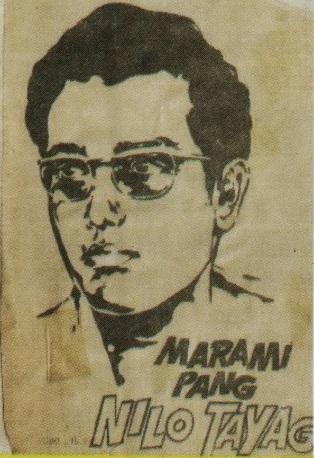
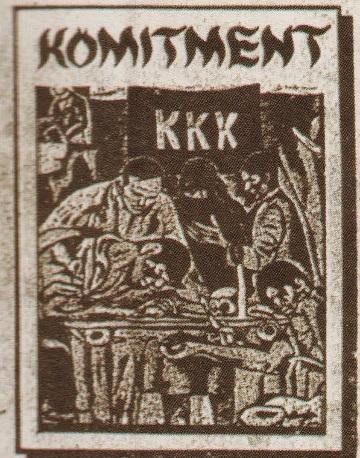
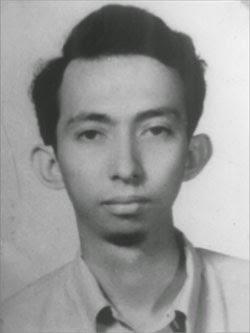
No one projected UP Alpha Sigma's activist image during the Seventies better than frat charter member and  Kabataang Makabayan (KM) 2nd chairman Nilo Salumbides Tayag. His Philippine Collegian article "Komitment" was required reading for Left activists.  In 1969, he was arrested by government agents somewhere in the Southern Tagalog region. In 1971, the frat initiated a highly successful info campaign called "Free Nilo Tayag Movement" Thousands of posters and t-shirts bearing the above image of him were printed.  After the campaign, Nilo was elevated into national icon status, which inspired a whole generation of activists, me included. (Photo from  The Revolution for Filipinism by Bishop Nilo Tayag)


Jesus Flor "FF" Fernandez


Jess and I were already close friends when he invited me to join Alpha Sigma. During off-class hours, he told me the history and orientation of the fraternity, in an obvious pitch to make me join. It probably helped that Jess, an underground operative, already knew me as having activist views, that he became interested in recruiting me into the fraternity with the Leftist reputation.
Jess was also fondly called “FF” because of the last 2 letters of his initials. However, after I got into Alpha Sigma, I found out that FF also stood for “Fighting Fish,” or what 8 mm. porn films were called in those days. During Alpha Sigma drinking sessions, Jess always had a spool or two of Fighting Fish films ready. Because of Jess’ persuasive invitation, and because I already had a number of trusted friends in Alpha Sigma, I decided to join. What Jess slyly did not tell me, however, was what went on during the frat’s week-long initiation. I had an inkling that it was tough and hesitated momentarily. However, my better judgment told me to go ahead.

https://blogger.googleusercontent.com/img/b/R29vZ2xl/AVvXsEgI5WBmmSm_Vs2eqX3bxzKSYlZC7IPcrwHJ5l_MDlvmd9aVeh51dfptQSca9krYlqWLgPbqQQPzt_pvGUQa8Mk73xOJgjkNYtazArIxUQpMC1JMU9N7RHZyZuRBh0is74vEL5bHmj3njhs/s1600/jesus+flor+fernandez.jpg
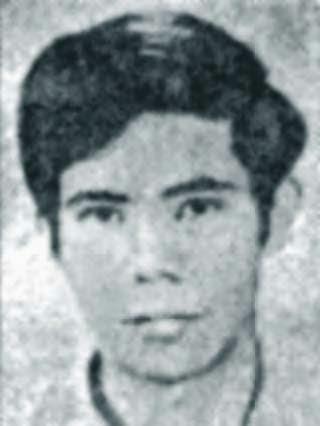
Jesus Flor "Jess" or "FF" Fernandez. He was the one who got me to join UP Alpha Sigma Fraternity in early 1974.We were both political science majors and members of the UP Political Science Club. Jess graduated from San Sebastian College High School and was a member of the pre-martial law mass organization Student Alliance for National Democracy (STAND). We were close friends even before I entered the frat. Jess was known for his earthy and infectious sense of humor. He and his girlfriend at that time Marife Fetalino coached me on the rudiments of activism. He stuck by me during the physical initiations. We often hung around in his home on Ermin Garcia St. in Cubao. I often rode on his bright orange VW Brasilia. He was a very good driver even though he had one bad eye. I wondered though how he got his driver's license.  (Photo by Bantayog ng mga Bayani Foundation)


Antonio Tagamolila


An event that inspired me to join Alpha Sigma was the funeral of Alpha Sigma member Antonio “Tony” Tagamolila in February 1974. Tagamolila had joined the New People’s Army (NPA) a few years before and had just been killed in an encounter with government troops in Iloilo. Before joining the NPA, Tagamolila was an outstanding economics student, editor-in-chief of the official UP paper, The Philippine Collegian, and president of the prestigious College Editors Guild of the Philippines (CEGP).   

I was egged on by several activist friends to attend the funeral. I attended the mass at the UP Catholic chapel and the funeral at the Loyola Memorial Park. The fraternity handled these events, and, in a tasteful way, converted them into a cultural presentation of the Left.  They sang activist songs and shouted activist slogans, as they extolled Tony’s qualities and principles.

One memorable moment at the funeral was when a Masig, Joy de los Reyes, realizing that so many government agents had mingled with the medium crowd, defiantly shouted “Marcos Hitler Diktador Tuta.” Joy had long been the fraternity’s slogan shouter because of his booming voice. I admired Joy’s courage, because he could have been arrested on the spot. After all, martial law was not even 1 and ½ years old at that time. At any rate, after the funeral, I decided that this was the fraternity I would join.

https://blogger.googleusercontent.com/img/b/R29vZ2xl/AVvXsEjgXAMFA8vvybk2M3Jh0htLLBx5tl7dq4ZI02zbV3ZkCMC5qqaJ-POZU9DgaQLr-M3Og-YIul3_rkou__7PiyXqi1iUudrkdMsc4GbHfojTSM4ly4Da90z9i8KAjCQHdCO-k06eL2I-D6g/s1600/Antonio+Tagamolila.jpg
Antonio Tagamolila: UP Alpha Sigma, former editor-in-chief, Philippine Collegian
and president, College Editors Guild of the Philippines (CEGP). He had a brother, named Crispin, who, as a 1st lieutenant in the Philippine Army, raided the Philippine Military Academy armoryon March 29, 1971, along with another lieutenant, Victor Corpuz. Crispin Tagamolila and Corpuz then joined the communist New People's Army (NPA)  and delivered to the latter the firearms they took inthe raid.   
(photo by Bantayog ng mga Bayani Foundation) 


The Paddle

The first session of the initiation was called a “presentation”. I was “presented” to the fraternity at the residence of medical student Danilo “Danny” Sacdalan. Danny’s home was located in the  campus, a short walk from Romulo Hall, and along Katipunan Avenue.

There was just a handful of Masigs or “brods” attending. It was just me being presented, but I was told there were others who were entering Alpha Sigma with me. They blindfolded me, removed my wallet from my back pocket, and checked if had any kind of padding on my rear to dull the pain. Then, without much introduction, I received the initial 5 “paddles”.

The “paddle” was a mean piece of hard wood, about a meter long, an inch thick, and about 6 inches wide. It narrowed down considerably at one end, so the user could use both hands in powerfully whacking it at a neophyte’s posterior.

While blindfolded, I remember hearing someone blurting out: “Assume!” After this command, I was made to bend over and spread my legs a little. Two persons held on to my upper arms to support me. I prepared myself for the incoming blow, but I had no idea how hard the paddle would hit.
https://blogger.googleusercontent.com/img/b/R29vZ2xl/AVvXsEgZ162nCuPeBCgXYEAeLfrDcpAhJyajBzH1OV0Ni_MaWq8bdxMplZshkImfxqPH1qZYMH5p91OcR4hsJm1zPMQt8Y81g4z5js22Z50QQ3PzJygKamLdPcf42CEEuAEwWSL9O9c3TdOPhok/s1600/Joy+de+los+Reyes.jpg
Joy de los Reyes was Alpha Sigma's resident theoretician, philosopher, and slogan shouter. His booming voice could project "Marcos Hitler Diktador Tuta" around a 100 meter radius. He did so at Loyola Memorial Park during Tony Tagamolila's funeral in 1974, when he noticed so many government agents around. An audacious act, considering martial law was at its most repressive at that time. Joy died of lung cancer May 3, 2013. (Photo from ellentordesillas.com)

The first paddle gave my buttocks a profound pain that lingered many seconds after it struck. Instantly, it dawned on me how tough this frat initiation would be.

In fairness to the Masigs, they waited for 10 to 20 seconds before delivering the second paddle, and so on until the fifth one. I bit my lip after every wallop landed.  By the fourth one, I had decided that I was going to endure this week-long thing and be a full-fledged Masig. When the fifth paddle hit, I remember my ass was already numb.

The next day, the entire batch of neophytes was told to go to Vinzons Hall at 12 o’clock noon. The Vinzons Hall cafeteria was where the Masigs usually had their lunch, together with the Sigma Alpha, their sister sorority.

https://blogger.googleusercontent.com/img/b/R29vZ2xl/AVvXsEh5Keh53hBuOmOmLAgW0ZM2ehNwfpNO6Tz4JRYXRKyB9QZR93CQCKu07IKSy4bPqsfK8XB73cVvE3R8HA2-n0crnaxi7k5wGZ-yd3oUpypIAs1Ap0_6x2fqT2i6FXYIp75bu-mmoJB0ghk/s1600/Alpha+Sima+2.jpg
The seal of the UP Alpha Sigma Fraternity. Frat lore has it that the
founding brods had the legendary Alpha Sigma  bulletin board bearing the seal
engraved on narra wood in Paete, Laguna
(photo from Alpha Sigma Facebook]


Public Humiliation

It was time for the public humiliation part of the initiation. Most of the batch did not have classes at noontime, so the Masigs had more than a handful to embarrass.

The Masigs, or, as we were required to call them --- “masters”, ordered us to do demeaning things, like serving them food, rubbing their shoulders after eating, and telling us to give flowers and publicly court or woo any random girl who happened to be eating lunch.

I gutsily played along, because I really wanted to be an Alpha Sigma. One Masig, Soliman “Soli” M. Santos Jr., even gave me a rose and told me to present it to his girlfriend, Doodie Martinez, who was enjoying her lunch. I did just that, and added some theatrics, like singing to the lady while falling down on one knee. It was fun.

In the one-week period of the Alpha Sigma initiations, my vacant periods from my studies were spent being the willing fool in these public degradation sessions. On many occasions, we were required to spend time at the frat “tambayan” (hangout) at the College of Arts and Sciences (CAS) second floor lobby.


https://blogger.googleusercontent.com/img/b/R29vZ2xl/AVvXsEhmCtCLGTavFLlzYpVbqlCi6ZDFY02j-X_p1DMBHbJbyxptqD-NSKv3wag-3LHBBnAdFI2tXIon-S3yNKGEFou2pdsKTRQAEItUcPzQajdaMAEMoW_7iiI1zXml_NGrDxEFGcjIoqkSRqU/s1600/Alpha+Sigma+1.jpg
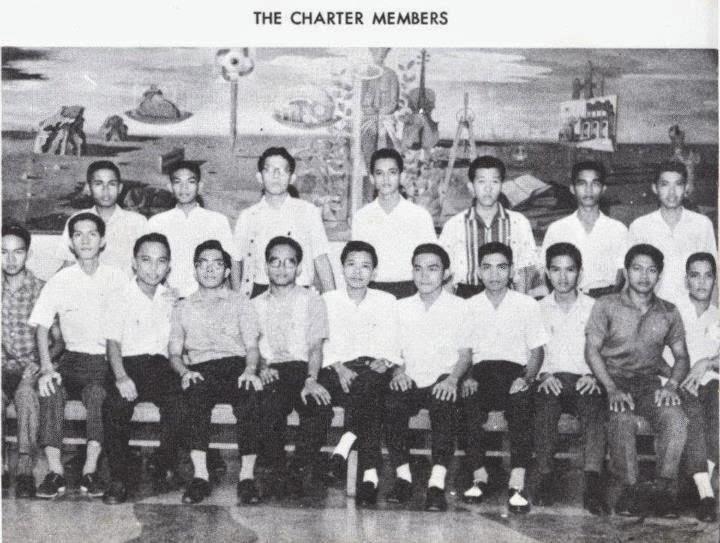
Charter members of the UP Alpha Sigma Fraternity. The fraternity was founded
on October 10, 1962. In the early days, Alpha Sigma admission had a general weighted average requirement of 1.75 (Photo from Alpha Sigma Facebook)


Second Floor CAS Lobby Tambayan : The BB

The Alpha Sigma tambayan was a well-known place in CAS. Located at the entrepot that was the second floor CAS lobby, it consisted of two long benches at a right angle to each other, with one having its back to the academic oval, and the other against an imposing concrete wall on which hung the fraternity’s ornately carved narra bulletin board, or “BB.”

Within Alpha Sigma, the tambayan was endearingly called BB. The bulletin board itself was a sight to behold. Measuring about 1.5 meters by 1 meter, it was carved in Paete, Laguna out of narra hardwood. At the center, framed in a square, were engraved for posterity the letters A∑. From behind these letters emanated majestic rays of light, which had been so skillfully depicted by the Paete sculptors. At both sides of the BB were either empty polished spaces or shelves --- here memories fade.

To top it all, the BB was varnished a stately golden brown, and polished from time to time, such that the wood grain stood out and it shimmered when touched by the afternoon sun. To the Masigs, it was an enduring symbol of the fraternity. 

During a rumble with Upsilon Sigma Phi  fraternity some years later, I heard that our opponents plastered our beloved BB with human excreta. My heart broke.    

At the BB, the Masigs told us to do menial things, like massaging their backs and feet, and buying them things like food, cigarettes, and bluebooks. It was here that I finally met the leader of the frat, who went by the title of “Lord Chancellor,” or “LC” for short. His name was Alex Erlito S. Fider, a tall, skinny, and bespectacled fellow. Erlito wore glasses and sported bushy hair, and was an economics major.

The BB was also the best place to accomplish another neophyte requirement --- a notebook containing the name, nickname, batch, year and course, phone number, address, hobbies, achievements, and birthday of as many Masigs as possible. The neophyte would politely approach the Masigs, introduce himself, and request the former to fill up a page. At the bottom of the page the Masig usually wrote a dedication, or some words of encouragement. 

Another humbling thing I had to do during the initiations was go to Masig Butch Denoga’s house along Timog Avenue, Quezon City, on a Sunday morning, to wash and polish his pet Volkswagen Beetle.


https://blogger.googleusercontent.com/img/b/R29vZ2xl/AVvXsEg2-AgRAzid9idqduUAffisn-pyni-v9mdOFJ-b1QffCGy475NG1i6xj2Dfn4ZjW_r4nKVzsUadbY_x-thueSjTLinObIfI2F0ImgeTyNWzCSPIV2ri0d0fhxz5y1IVDwnxT97lbEVRgLk/s1600/Jose+Pepe+Luneta.jpg
Another UP Alpha Sigma hero/brod was Jose "Pepe" Luneta. He was a founding member of the frat on October 10, 1962, Kabataang Makabayan on November 30, 1964, and the reestablished Communist Party of the Philippines (CPP) on December 26, 1968. He was arrested by Philippine intelligence agents in early 1976, and made a successful escape in the early 80's. I never met him in UP, but when I was detained at the Bicutan Rehabilitation Center in 1979, we met and became friends. (Photo from UP Alpha Sigma Facebook)

https://blogger.googleusercontent.com/img/b/R29vZ2xl/AVvXsEiiTcsNrunEDmJXaTyXypOuByy3ETxPuBIaBnsPlQTCwLNPKbtm8VQJhQGKIntKpWmBNVs3p-niBhn8bnjRlmY5QKksBN0uoKIIJtu5Fl4yKM66lQfPEwAUv441Adodn68HAbBn6paRIuU/s1600/Alpha+Sigma+3.jpg
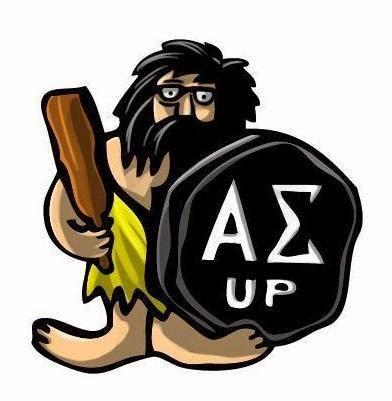
Ubag, the UP Alpha Sigma archetype representing Jean Jacques Rousseau's noble savage. Ubag is Alpha Sigma's contribution to romantic primitivism.
Translation: simple lives but complex minds.   (Photo from Alpha Sigma Facebook)


Very Safe Physical Sessions: No Blows to the Back, Chest, Abdomen, and Head.

The physical sessions, which formed the essence of the initiations, were conducted after classes, starting at about 7 pm. They were conducted outside the campus, and always at the residence of a frat member. They would last until 11 or 11:30 pm.  

We underwent 3 of these sessions, with the third one being the harshest.  The latter was aptly called the “Finals”.

Compared to these sessions, the presentation was a breeze. For starters, there were more Masigs present. During these pre-finals sessions, there must have been 20 to 30 Masigs present. This meant that there were this many “masters” who would kick or punch your four limbs, taunt you, insult you, take turns hitting your ass with the frat paddle, and whose first name, surname, and last name you had to memorize, under threat of more bodily punishment.

Secondly, we were paddled as often as the number of letters in Alpha Sigma Fraternity. I realized then that 20 paddles delivered at full force could really test one’s resolve.

To our relief, the paddles were given in sets of 5, and in intervals of about 15 seconds. The sets, in turn, were given at intervals of about 30 minutes. Otherwise, I thought, we pitiable “amuyongs” would have passed out from the agonizing pain.

In between the paddle sets, each of us were surrounded by 4 to 5 Masigs, who took turns punching us repetitively on the upper arms, and giving us knee blows on our buttocks, and behind our thighs. I noted that the disciplined Masigs did not hit us where it could be fatal, like the back, chest, abdomen, and of course, the head.

https://blogger.googleusercontent.com/img/b/R29vZ2xl/AVvXsEiodDjj9HqwglMiw4D-Uqbjz16wMe-0wYGxnlo-92USufl1a4GVR6Eo97CmV6AS6iRFQjvEyhycAxCug_g9H_9kdvq8ZRuxhDAWTvShgMT5WVaDasGE2lNzX0kbCl8ZzpXyon5E6UtLJyE/s1600/Alpha+Sigma+4.jpg
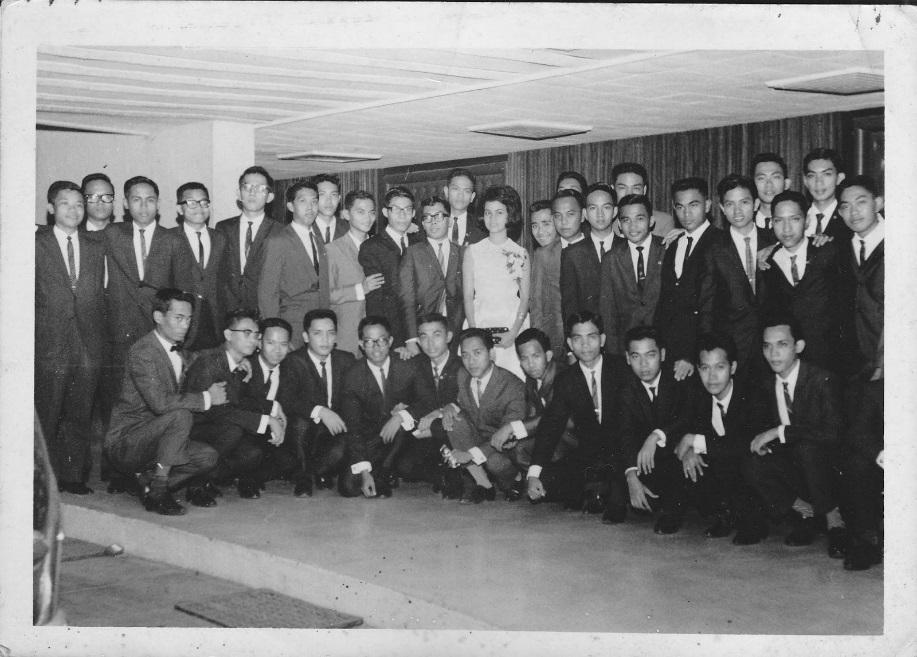
A UP Alpha Sigma Anniversary ball, sometime in the
early Sixties, at The Aristocrat Restaurant,
Cubao. (Photo from Ubag Facebook)


In All Fields of Endeavor, the Mark of Excellence

In 1974, the memory of the 1967 death of engineering student Ferdinand Tabtab during the initiation rites of the UP Alpha Phi Omega Fraternity (APO) was still fresh. The Masigs, to my mind, were obviously under instructions by the Alpha Sigma officers to avoid a repeat of that tragedy.

Today, however, when I think of my widespread bruises during the beatings, I shudder to think that just a tiny blood clot from the bruises could have travelled through my veins, caused a blockage somewhere , and killed me.

While the Masigs were pummeling us, they repeatedly and toughly drilled us to be loyal to the fraternity, to love the “brods”, practice brotherhood, and abide by the frat’s principles. The three most repeated maxims were “Alay sa Sambayanan” (Offered For the People), "Truth, reason, and justice), and “In all fields of endeavor, the mark of excellence.” We would answer every instruction with a submissive and brisk “Yes master!” Who wouldn’t?

When the first session was over, I remember my upper arms and the backs of my thighs were bruised a deep purple. I also had difficulty walking, because of the pain in my ass. 

Before the maulings, there was that part where the neophytes were required to identify the Masigs by their complete names. They were conveniently assembled in a standing semi-circle.

The customary position while identifying the members was to have your left arm bent at a right angle pointing upwards, while your stretched right arm  with palm exposed pointed to the Masig you were identifying.  Mistakes, which often where made when it came to the middle names, were penalized with either extra beatings, or an extra paddle or two.

Before the sessions therefore, we wracked our brains memorizing the names of as many Masigs as possible, whether they have signed our notebook or not. The identification part was about the only part of the session where we did not have our blindfolds on. By the way, we were also required to memorize the complete names of the charter or founding Masigs --- all 18 of them. The frat was founded on October 10, 1962.

https://blogger.googleusercontent.com/img/b/R29vZ2xl/AVvXsEjJjfMtIiw0BxfLItgFmelO2EjIbGUyU5oOOzIVYVtjrA53FD0hnPpB9E9zLFUu-PnA2EbpEMw9AWmVDV69XsR0lyCT_-lT-GjZihQSmUkutmoxcNDtpes3z8auZWSO8kj037LV3kcmXVE/s1600/Alpha+Sigma+5.jpg
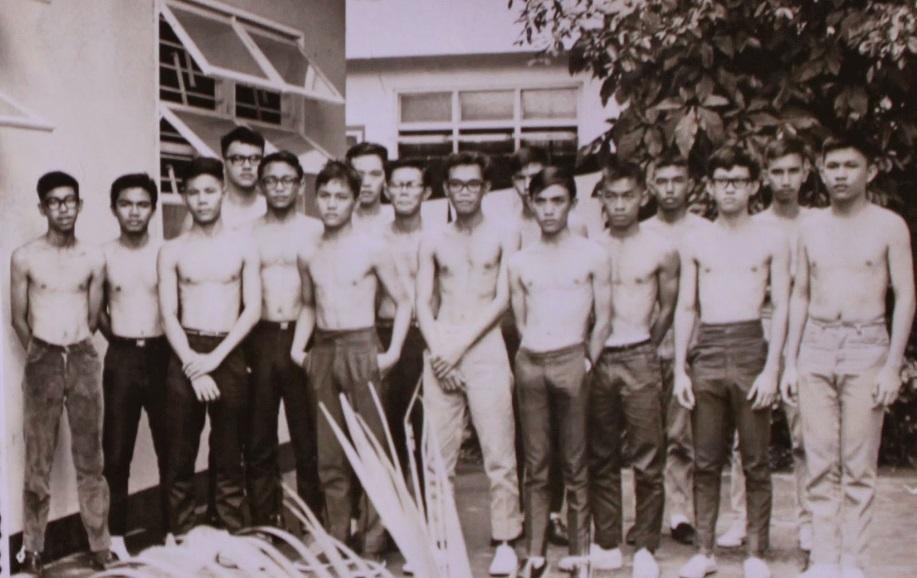
Half-naked Masigs, mid-Sixties. No jogging or lifting weights for these guys.
Most of them were drinkers and smokers. But they made some of the
more glorious chapters in Masig history. (Photo from Alpha Sigma Facebook)


The "Sadistas"

There was also the danger that a neophyte might casually incur the ire of a hot-tempered Masig, or what was informally called “sadista” (sadists). These were the Masigs who, for the slightest or no reason, would beat the hell out of a neophyte (within safe margins of course), or paddle him as hard as possible. Fortunately, we knew who these Masigs were, and we made extra efforts to memorize his complete name, and know his every quirk.

The "sadista" Masigs whose names I remember were Masig David Fernandez who was also nicknamed “racha,” which was a Tagalog colloquial for beat completely, and Mario “Mar” Padua, whose stare could kill any neophyte. After the initiations, to the batch’s surprise, Dave and Mar turned out to be very nice brods.

To even things up, there were also the compassionate Masigs, those who would just pretend to beat you up, like giving soft blows, and soft paddles. They would also gently whisper words of encouragement in your ear in the heat of the beatings. This helped a lot.

Most of these nice Masigs were the national-democratic or Left activists, who shunned overly hurting neophytes. Probably it helped that they knew I already had activist leanings,  because I felt that they were singling me out for soft treatment and words of encouragement midst my agony. The Masigs I remember doing this to me, kind souls all, were Jess Fernandez, Romeo “Ome” Candazo, and William “Billy” Begg.

The 3 are now no longer with us. Jess Fernandez died of cancer in 2007, Ome Candazo died of a heart attack in 2013, and Billy Begg died, as an NPA, in an encounter with government troops in 1975.

https://blogger.googleusercontent.com/img/b/R29vZ2xl/AVvXsEjG35N2nNNFG5L7m7fyzqR5S9EwxZuBdqTrmwTlF6MpOTdJB1MEZy59nv58cjM6KBuG_H5JPIAHyAe0G7Ij-E4HB2MDI5W4RBQENOFTE0AUXVNbAtGutgC62JzhDDACgCXKWmuVcHddKz0/s1600/Billy+Begg.jpg
I remember William Vincent "Billy" Begg  as the brod who supported my arms during the furious paddling,
and who whispered comforting words to my ear during the rest periods. I played basketball against him once --- he was a very quick point guard who ran circles around me. Probably learned the game in minor and major seminary, from where he came going into UP.  One of the gentlest Masigs of my time. (Photo from Bantayog ng mga Bayani Foundation)

Alpha Sigma "Pulajanes"

I later learned that the Left activists within Alpha Sigma called themselves the “Pulajanes,” in honor of a suicidal Filipino resistance group in Samar during the Philippine-American War from 1899 to 1903.

Aside from Jess, Ome, and Billy, the Masig Pulajanes I remember were Daniel C. “Gut” Gutierrez, Alex Erlito Fider Jr., Soliman S. Santos Jr., Renato S. “Rene” Velasco, Joy de los Reyes, Jesus “Jess” Lagunzad, Diwa C. Guinigundo, Alex Africa, Felipe "Ipe" Reyes, and Roli G. Talampas. Raul Pangalangan, Ruben "Benrubs" Edejer, Sabino "Abe" Padilla, and Arnel "Batman" de Guzman were also Masig Pulajanes, but at that time they had not yet entered Alpha Sigma. 

I remember the two pre-finals sessions were held, respectively, at the houses of Masigs Renato S. “Rene” Velasco in Caloocan, and Soliman  M. Santos at 18 Mariposa St. in Cubao, Quezon City.

At that time, I went home to Bulacan, Bulacan, which was about an hour and a half commute from Metro-Manila. The problem was that the sessions finished at about 11:00 pm, while the buses I took to our house only made trips up to 10 pm.

To reach home, therefore, I rode the Bocaue, Bulacan bound Sarao-type jeepneys at Monumento which ran trips 24/7. At a junction in Brgy. Wakas, Bocaue, Bulacan, I asked my kind parents, Domingo Coronel Reyes and Eneida Enriquez Reyes to pick me up at something like 12:00 midnight. They were just too happy to fetch me even at that unholy hour.  

It was somewhat dark, so they did not notice the extensive eggplant-colored bruises on my arms, at least until we got home.

https://blogger.googleusercontent.com/img/b/R29vZ2xl/AVvXsEir_GLKqbimgT5dZnw0iMm1l_i5fwtIqaX0hof4rJ-6eFqMVfFIkUXcV7dJioGkkG9QzT2YF4SRc3twvH9VtGkWfsvsXuNqhTJa7KhDXpcMWBHofCMbBpvltIhC3-Vb4C9rmdzKbnZosu8/s1600/Alpha+Sigma+6.jpg
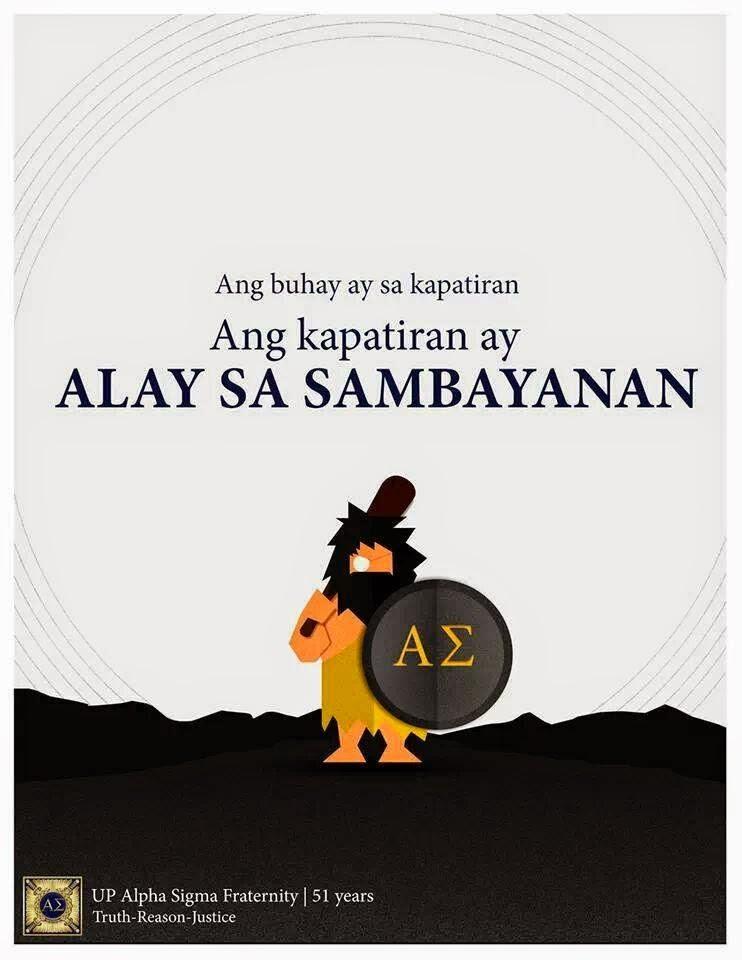
Alay Sa Sambayanan and the frat motto: Truth, reason, and justice. (Photo from Ubag Facebook)


The Finals

The final session was held at the house of Lito Tiongson, a Masig who was an aspiring script writer for films and documentaries. I remember Lito’s house was in Project 8, Quezon City. Lito has also passed on, many years ago. When he died, Lito was a professor at the UP College of Mass Communications, and a multi-awarded writer.

The finals was more violent than the previous two sessions, for two reasons.  First, the amount of paddles we received was not only equivalent to the number of letters in the frat’s name,   but also included the number of letters in our respective complete names, and “Alay sa Sambayanan.”

In my case, I would receive 56 paddles that night, compared to 20 apiece for the preceding sessions. Overall, I received 101 paddles for this Masig initiation, and God knows how many other blows.  

Second, the number of Masigs who attended final sessions was traditionally the highest in the whole initiation process, roughly, 50% more.  The number of punches and kicks a neophyte was to probably receive, therefore, increased by this scary magnitude. And it did.

https://blogger.googleusercontent.com/img/b/R29vZ2xl/AVvXsEiPQw2OFiXmy5wsjri1rzTugw1I8SVmKz1cu993rgagFtvk6BRy5xXdrvDE7HNt1W_DF876Z6qz9W-SxwNEjBvQ8rLWSQ8D1P3M5mvwXucS32bzIMqFgIaBrR7M6G7sXGpjQqAtqYZt17s/s1600/Ome+Candazo.jpg
Romeo "Ome" Candazo was one of the ardent Alpha Sigma "Pulajanes." He became its"Lord Chancellor" (LC) sometime in 1974. Another close friend and brod. I was arrested and detained twice during martial law, once in 1975, and again in 1979. In those two times, we were together. There's nothing like going through a life-threatening experience together to preserve a friendship. On our 2nd arrest, when we were both blindfolded and handcuffed in Camp Crame while awaiting interrogation, he jokingly whispered to my ear --- "Brod huli nanaman tayo" (Brod, we've been arrested again). That single statement, spoken so nonchalantly, eased my fears somewhat.  Ome was once a columnist for the Philippine Collegian, going by the name of "Ahas Tulog" (Sleeping Snake). He once used my name to depict a hungry street boy who was oppressed by the system. One of his classic pieces, the column was titled "Nang Kumulo Ang Tiyan ni Beto" (As Beto's Stomach Churned) Ome Candazo died of a heart attack on August 19, 2013. (Photo from Romeo Candazo Facebook) 

The Gauntlet and Lots of Tancho Tique

After we had gone through the paddles, the identification part, and the indoctrination underscored by severe mauling, we braced ourselves for the last part of the finals, which we were told was the no-holds-barred “Gauntlet.”

We were blindfolded, but prior info had it that the Gauntlet consisted of the total number of Masigs in attendance standing in two parallel lines facing each other. Given the number of Masigs that were in attendance, those two lines must have been more than 20 feet!

The batch of neophytes were to slowly walk between the two lines, and we were told, frighteningly, that the members were authorized do as they pleased to us. We were even warned that many Masigs carried a paddle, or a club, or even pots and pans.  Everyone in the batch braced for the worst.

But first things first. Before we were lined up to go through the Gauntlet, the Masigs massaged into our hair the most generous amount of Tancho Tique hair pomade I had experienced in my life. As they were doing this, we were like docile pigs getting groomed just before the slaughter. The excessively fragrant  and gooey Tancho Tique nauseated me, but I shook it off.

Then, they gave each of us a comb and told us to use it so we would look good as we were being assaulted. They warned that neophytes with unkempt hair would be battered the hardest. I must have combed myself like Rudolph Valentino.

Show Us Some Guys

And so the fateful moment arrived. Alpha Sigma Batch 74-B, was now ready to attack the Gauntlet.  The seven of us were lined up, told to put our hands on the shoulders in front of us, and blindfolded. In the case of the lead neophyte, he was told to put up a battering-ram stance.  

The Masigs shouted obscenities, taunted us, or otherwise made mincemeat of our remaining pride. But we put these all in stride, as all of us wanted the initiations over with. Our twenty-something bodies had fared well through it all.  The adrenaline was flowing, and our spirits were high.

We charged like hell into the Gauntlet as if there were no tomorrows. As Tennyson put it, ours was not to reason why, ours was to do and die. As we advanced, anticipations of pain, suffering, anatomical dislocation, or even death flashed like a carousel in my mind.

In about 20 seconds or less, it was all over. We were not hurt ----- we were only pushed, shoved, and cajoled to negotiate the Gauntlet as quickly as possible.

As soon as the entire batch was outside the Gauntlet, the menacing column broke and transformed into a cheering crowd.  Spontaneously, the Masigs erupted into a triumphant rendition of the UP Alpha Sigma hymn “Show Us Some Guys.” 

Above the din, the operatic voice of brod Pons Raya, a member of the UP Concert Chorus, stood out. The emphatic refrain went like this:
           
“You can have your cup of equity,
But we know one thing with certainty,
It’s unfair but we're there,
We're beyond compare,
Alpha Sigma Fraternity!”

We were Alpha Sigma brothers at last. They were embracing us and calling us brods. The batch, to a man, was in tears. We were so happy we forgot the pain, the humiliation, and the Tancho Tique.

Monday, April 18, 2016

Summer 1974: Pabasa, Basketball, Libots and Flores de Mayo in Bulakan Bulacan

The second semester having ended, I spent the entire 1974 summer break in my hometown, Bulakan, Bulacan. Our barangay's name was Maysantol, but it was also called Kupang.  It was a busy summer, busier than usual. UP politics and anti-martial law protests were far from my mind.  Little did I know that this summer would be one of the last authentic and personal enjoyments of my hometown I would experience before my activist career began.

I spent this summer hanging around with my barkada, which consisted of Edmund Reyes, my younger brother, my second cousins Tony Enriquez, Jun Enriquez, and Val de Jesus, and our next-door neighbor Edjie de Jesus. We whiled away time in front of Horacio's sari-sari store across our house, which had in front of it two worn out but glossy bamboo benches, facing each other.


Photo shows my barkada in Bulakan, Bulacan during much of the Seventies. We were having a picnic in the garden  in front of our house. We were feasting on pakbet, longganisang Bulakan, inihaw na bulig, (grilled mudfish), suman (glutinous rice wrapped in banana leaves), bananas, San Miguel and Budweiser beer, Johnny Walker whisky, and Remy Martin cognac. I'm the one in  light-blue shorts. My elder brother Luis E. Reyes is the one holding a beer bottle at the extreme left. The one sitting is my brother Edmundo E. Reyes. Drinking from a Budweiser can behind Edmundo is my second cousin Antonio E. Enriquez. The one wearing the Lee t-shirt is another second-cousin, Emiliano "Jun" Enriquez.  At the extreme left is Mario de Jesus, and to his right is our guitarist, Gener Candor. Holding a San Miguel Beer bottle behind me is Gener's elder brother Titot Candor. This picture was taken on November 25, 1979.

I also participated in an uneventful  barangay inter-color basketball league, which played about thrice a week on a clay court and at early evening. Dribbling was hard and a sweaty player really got dirty upon falling on the court. However, with the wild cheering of the barangay folk for their team of choice, the lowly basketball court might as well have been Araneta Coliseum to the players. 

The tournament ended abruptly in a court-wide rumble with no champion being declared. I belonged to the Tangerine Team, and my number was 77. Sometimes I even did the play-by-play announcing over a loudspeaker, being very good at it, I'd like to think.  I did it in Bulakan Tagalog!


This is the "half-court" behind our house. I am hoisting my then two-year-old
son Nikko to try to shoot the ball through the hoop. This was taken in 1985

Lastly, and not in the least, I was elected, via viva voce,  president of the barangay church youth organization. This organization of teenagers and twenty somethings was in charge of conducting the Holy Week pabasa, or the singing of the Philippine Pasyon in March, and staging the annual Flores de Mayo in May. 

It was based in the barangay "bisita," or chapel, which was located some fifty meters from where I lived. The barangay people referred to it as the Pamunuan ng Kabataan or just plain pamunuan. There were two presidents actually, one for the men, and the other for the women.


This picture shows some of my basketball mates, many of whom are about ten years younger than me. We had just played several furious three-on-three games on the half-court behind our house. Standing at the extreme left, front row is my younger brother Edmundo, while another younger brother Vincent holds the ball. 

 I remember going house to house raising funds for the Flores de Mayo particularly to pay a fourteen man band or musiko. I even went to friends and relatives outside of Bulakan, Bulacan to solicit money. As president, I had the time honored duty of providing from my pocket a hearty dinner to them right after the 9 pm procession. They had walked some two hours and several kilometers around our barangay while carrying and playing their instruments; the men were very hungry. They ate at our house.

The musicians set aside  their instruments at one corner of our house and went straight to the dining table. They understandably made short work of the nilagang baboy, chicken in cheddar cheese sauce, and rellenong bangus our maid Ka Sila had prepared, all for the grand sum of fifty pesos.  After eating, the men sat in our living room for about an hour and smoked a lot.


Some have left while a few have joined our group in this pose. I am partly kneeling with the ball, my younger brother Vincent gives the highest victory sign. My nephew, Raul Enriquez, in the blue t-shirt, is at the extreme right. 
After paying the leader of the band, something like two thousand pesos, I saw them off in their long Sarao jeepney in front of our gate. It was already 12 midnight, I had been up since 5 am, but I still had enough energy to clean the mess in our house the band left behind. It is amazing what a twenty year old body can do. After washing my face and brushing my teeth, I dozed off in my unkempt bed. I slept oh so soundly, I was dead tired.   

Before the Flores de Mayo, the pamunuan sponsored nine consecutive, nightly mini-processions, commencing at 9 pm, that were devoid of the gaudiness of the Flores de Mayo. They consisted merely of just twenty to thirty plainly dressed and slipper-clad young and older people carrying candles or kerosene torches.


My barkada on our way to Baguio in 1980. We were in Plaridel, Bulacan, and we thought the historical marker would be a great spot for a group picture. The marker commemorates the place where Col. John M. Stotsenburg of the US Army was killed by Filipino snipers on April 23, 1899, during the Philippine-American War. I am the one wearing the white t-shirt and shades. My brother Edmundo is standing at the extreme left, my brother Luis is standing at the extreme right, while my brother Vincent raises his clenched fist second from the left back row. At fourth from the left, back row, is my youngest brother, Francis E. Reyes.    

Each procession wound their way through the nooks and crannies of our barangay, making the full route, some three kilometers, in about an hour. Because of this, they have been called libot in our barangay, which is the Tagalog word for wandering. I remember we had the libot around the first week of May, and the Flores de Mayo during the last week. 

In the middle of the procession was a line of about three to four female children five or six years old, each carrying a religious object that looked like a one foot square picture of a saint or of the Virgin Mary, which were called estampas. Each estampa had at its top a small crucifix about four inches high and three inches wide.

The children were dressed in modest but somewhat worn out long gowns and  were accompanied by adult women. These were usually their proud mothers, who guided them by their wee hands, and cajoled the by now sleepy tots to keep pace with the procession. 

For these austere processions, these children were the substitutes for the sagalas or the various heavily made-up and fabulously attired queens of the Flores de Mayo. At the end of the libot, the estampas, holy and antique icons as they were, found their way to a secure bin near the altar of the bisita.  

At the rear end of the about twenty meter long procession, the male youth of our barangay congregated, consisting mainly of my barkada and then some. There were also five or six male adults in their forties, which we looked upon as already "old," calling them appropriately enough, katandaan or the old folk.   

The rear led the singing for the procession, with a guitarist always present. The older folk sang a lot better than we did. The outstanding singer was my second cousin, Raul Enriquez, who was an outstanding tenor. We respectfully called him Ka Raul. 

There were other quality voices in the older group, and one of them was Ka Raul's younger brother, Recaredo, whom we called Ka Rec. Ka Rec was was an active duty policeman in our town. Another notable voice belonged to bald Ruben Morelos, who was a wistful baritone, and whom we affectionately called Mang Ruben. Together, the rear group would lead the singing of the Spanish version of the Hail Mary, or Ave Maria, until the procession ended. 

We interchangeably sang the Ave Maria , or what we informally called the Dios Te Salve in two melodies.  The guitarist of choice was Gener Candor, or Negi, owing to his dark complexion. Gener was the best guitarist in our group hands down. The other procession marchers, most of them women,  sang along, which melodious chorus, to my approximation, was a mixture of the solemn and the festive. 

The Ave Maria went like this:

"Dios te salve, María, llena eres de gracia, 
el Señor es contigo. 
Bendita tú eres entre todas las mujeres, 
y bendito es el fruto de tu vientre, Jesús. 
Santa María, Madre de Dios, 
ruega por nosotros pecadores, 
ahora y en la hora de nuestra muerte. 
Amen."

I will never forget the smell of the kerosene torches, more than twenty five of them, and the yellow light and black smoke they collectively emitted, creating a surreal scene within the procession. It was as if the two twisted rows of torches were creating an eery, bright yellow and pitch black zone in between, where things were all in slow motion, and all you heard was the repetitive singing of the Ave Maria, and all you smelled was acrid burnt kerosene.  

If anyone was carrying a candle, his or her light was certainly overwhelmed by the torches and rendered unnoticeable. I surmised that there must have been very few candles in the processions anyway, because the bamboo kerosene torches, which I bought in bulk from Ka Rening, the barangay bamboo dealer, were cheaper, and were reusable besides.

At the procession's proverbial end, which of course was the bisita, all the libot participants partook of delightful bowls, five inches across, of either sopas, which was a creamy soup of elbow macaroni, chicken, and thin strips of carrots and cabbage, or arroz caldo, which was a thick rice porridge, ginger and garlic flavored, and provided with two or three chicken morsels per bowl. 

The steaming treats were cheerily served by the female officials of the pamunuan and some devout volunteers. Even non-procession participants, opportunists all, had their fill, for who could resist and who would refuse? Everybody was happy, because the supply was ample: it coming from two humongous calderos so big a toddler could hide in them. The merry eating, laughing, and flirting went on until something like 11 or 11:30 pm, after which everyone repaired to their houses.